Osteogenesis Imperfecta
Osteogenesis imperfecta (OI) is a genetic disorder that impacts how the body produces collagen, a protein that helps strengthen bones, which may lead to fractures and deformities throughout the body.
At Children's Healthcare of Atlanta, we’re dedicated to treating children with osteogenesis imperfecta (OI). Our OI Clinic combines the experience of our dentistry, endocrinology, orthopedic surgery, orthotics, otolaryngology, physical and occupational therapy, psychology, and pulmonology specialties to create comprehensive treatment plans for children with OI.
The goal of our program is to provide your family with a care team that can help maximize your child’s daily function and quality of life, from birth to 21 years old. We also offer prenatal evaluations and will work with your obstetrician on an appropriate birth plan. Our team will teach children with OI and their families what they should expect living with this diagnosis and guide them every step of the way.
If you would like to request an appointment with our OI Clinic, contact us by email or phone.
Our program combines some of the latest proven technology and research with a caring, child-friendly approach, making Children's a top choice for treatment of OI. U.S. News & World Report ranks Children’s as the top pediatric hospital in the Georgia and the Southeast*. Additionally, our Orthopedics and Sports Medicine Center is ranked among the top 10 programs in the country for kids and teens*. Children’s is also one of the highest volume pediatric hospitals in the country treating OI patients, prioritizing a research-based approach to care and coordinated efforts between the specialties in our program.

Your child’s nurse will perform an initial evaluation and check-in with your child at the beginning of your appointment.

During your child’s appointment, a pediatric endocrinologist, like Dr. Noreen Islam, will evaluate your child and make recommendations related to your child’s hormones to maintain or improve their bone strength.

Next, your child will work with a pediatric physical therapist, like Jill Cannoy, PT, DPT, PCS, whose goal is to teach your child exercises that can help improve their range of motion, coordination and balance.

A pediatric occupational therapist, like Lisa Patel, OT, will work with your child on developing independent function and skills important to daily living.

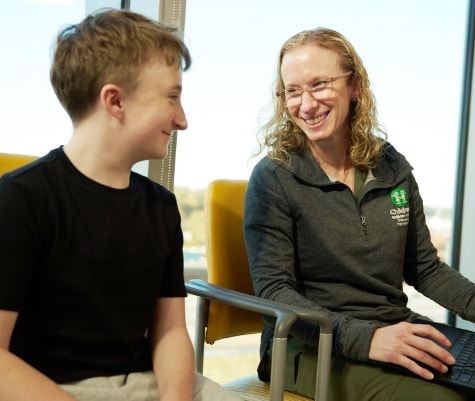
Pediatric occupational therapists in our OI Clinic, like Amy Bohn, provide task-oriented strengthening exercises to suit your child’s age and skills.

Finally, a pediatric orthopedic surgeon, like Dr. Jill Flanagan, will evaluate your child’s bones to decrease fractures and deformities as much as possible.

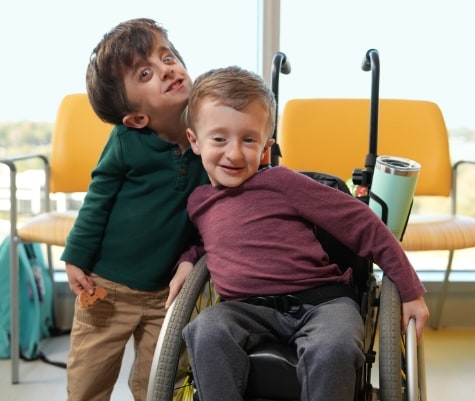
Throughout your appointment, you may see friends from Camp Wishbone. Dominic and Coale pose here with Jill Cannoy, after “pranking” her with sticky notes.
The doctors, physical and occupational therapists and psychologists in our Osteogenesis Imperfecta Clinic are experts in treating infants, children, and teens with osteogenesis imperfecta. They work together to help ensure each patient’s treatment plan is clear and comprehensive, so that families can work to maximize their child’s daily function and quality of life. Anna Rumrill, RN, serves as the current OI Clinic Coordinator. She works closely with the specialists in our program to help families navigate their care.
Our Dedicated OI Clinic Team
Endocrinology
Orthopedics
- Jill C. Flanagan, MD, FAAOS, Medical Director, Osteogenesis Imperfecta Program
Physical and occupational therapy
- Amy Bohn, OTR/L, CPAM, FASIA
- Jill Cannoy, PT, DPT
- Lisa Patel, MOT, OTR/L, CPAM
Psychology
An OI diagnosis can be overwhelming for families. Children’s is here to help support your child and family every step of the way. We’ll help you understand possible treatment plans and work with your schedule, including by offering same-day appointments. Children’s has resources to help your children live with OI, minimize fractures and find a good balance.
While there is no known cure for OI, current treatments focus on minimizing pain, maximizing function and decreasing rates of fractures and bony deformities. Our goal is to help children with OI live better, more fulfilling lives. Treatments include physical therapy, bracing, medications to make bones stronger and, occasionally, surgery.
If you have questions about your child’s condition or care, contact the OI Clinic by email or phone.
OI affects how a child’s body produces Type I collagen, the protein that forms bone structure. It is caused by either a lack of collagen or collagen that is abnormally formed. Since Type I collagen is also located in teeth, the whites of the eyes, ears, skin, ligaments, heart valves and blood vessels, the disease can also impact other organ systems.
OI is an inherited disorder that is typically passed down through families, but not always. Therefore, it is possible for your child to have OI without other family members being affected by it.
There are more than 300 known genetic mutations associated with the disorder, and some forms are more severe than others. There are four types of OI:
Type I OI (mild)
This is the most common and mildest type of OI, and it is likely to be inherited. Children with mild OI can have blue sclera, meaning the whites of the child’s eyes are blue, and teeth can also be affected (dentinogenesis imperfecta). Fractures do not usually occur until preschool, when the child is walking.
Type II OI (most severe)
With Type II OI, the collagen is extremely abnormal, causing the bones to be very weak. Fractures to the skull and ribs can occur while a baby is still in utero, causing respiratory failure and/or stroke. While the disorder was previously considered fatal, children now have a much better outlook thanks to advances in medical and surgical treatment.
Type III OI (severe)
Children with severe OI often have fractures when they are born and are frequently short and have a deformed spine. In the past, this condition decreased life expectancy, often because of respiratory illness, but with medical advances, patients with Type III OI are living longer, richer lives. Medications known as bisphosphonates make bones stronger and can be started as early as infancy.
Type IV OI (moderate to severe)
Children with Type IV OI are usually short in stature, and their teeth are affected by the disorder. Fractures and crooked bones are common. Pediatric orthopedic surgery is often required to protect bones against future fractures and straighten out crooked bones. Like children with Type III OI, children with Type IV OI can benefit from bisphosphonates, medications that make bones stronger and can be started as early as infancy.
The specialists in our OI Clinic focus on strengthening patients’ bones as much as possible. Our team uses a multidisciplinary approach to optimize your child’s bone health. This includes proper nutrition information, physical and aquatic therapy, and some children will receive medications (such as pamidronate) to help strengthen bones. At times, we recommend rodding surgeries to straighten the bones and decrease the risk of future fractures.
Strategies to improve bone health in patients with OI include (but are not limited to):
- Encouragement of weight-bearing activities. Use of braces, when necessary.
- Your provider may also recommend braces or arch supports for your child. Many children with OI have very flexible joints and flat feet, and these orthotics provide additional support for walking and running.
- Exercise and/or physical therapy–either on land or in the water.
- Taking adequate levels of daily calcium and vitamin D.
- When appropriate, medications to make bones stronger (for example, bisphosphonates).
- When appropriate, surgery to implant rods to straighten bones and protect them from future fractures.
There are two care phases for OI: the maintenance phase, in which our team evaluates your child’s bones and develops a treatment plan, and the acute fracture phase, in which your child has suffered from a broken bone.
Maintenance phase
During this phase, all efforts focus on strengthening the bones as much as possible, including through physical therapy and bracing.
For children with moderate to severe OI, we typically start physical therapy around 3 to 6 months of age. Therapy can either be “land therapy” or “aqua therapy,” depending on your and your doctor’s preferences.
Physical therapy is imperative for a young child with OI. Children learn balance skills to prevent falls and gain muscle strength and endurance. For an older child, there may be anxiety about walking and running. Working with an experienced therapist will get your child moving and keep them moving. Once you have a prescription from your provider, we’ll help you figure out therapy options.
Your provider may also recommend braces for your child’s ankles. Many children with OI have very flexible joints and flat feet, and braces provide additional support for walking and running. A supramalleolar orthosis (SMO) is the most common brace prescribed. It provides support for the ankle and can fit into most sneakers. The brace comes up to just above the ankle bones (known as malleoli). If your child benefits from an SMO when they are younger, they will likely transition to a shoe insert as they get older.
Acute fracture phase
We take steps to develop the right solution and treatment plan when your child has suffered a broken bone. Treatment options to address fractures in children with OI include treatment through medications known as bisphosphonates or surgical treatment.
Bisphosphonates, which are medications that can be used to strengthen bones, have revolutionized care for children with OI. In a process known as turnover, your body constantly breaks down old bone to make new bone. The medicine inhibits bone turnover to improve bone density, which can benefit children with more severe forms of OI. Your orthopedic specialist and endocrinologist will work together to determine if bisphosphonates may be considered in your child’s treatment plan.
For children with the more severe types of OI in which the bones are too crooked to stand on, your doctor may recommend placing rods in all four portions of the lower limbs. The rods most commonly used in this surgery are called Fassier-Duval rods, and are meant to not only straighten the bones but also to protect them from bending and breaking in the future. Positive results are not guaranteed, and not every child with OI should be considered for surgery.
Living with osteogenesis imperfecta can be a balancing act. At Children’s, we are here to answer your questions and help your child find the right mix for a healthy lifestyle.
Additional Information from OI Foundation
*Orthopedics Program ranked No. 9 on the U.S. News & World Report “Best Children’s Hospitals” list for 2025-26.