Season 2: Episode 12
Hope and Will: A Parenting Podcast from Children's Healthcare of Atlanta
Special Episode: Inside Our Helicopters and Ambulances
When a Children’s Healthcare of Atlanta helicopter flies overhead or a Children’s ambulance zooms past you, you know a child is in need of lifesaving care. Most of us are lucky enough to not know what it’s like on the other side of those doors. For those who have experienced being a passenger inside a Children’s transport vehicle, you know it’s a world where time stands still.
If you've ever wondered what it's like to be a crew member in one of our helicopters or ambulances, what happens behind the scenes after a call comes in, or what transpires after a transport vehicle arrives at one of our hospitals, this episode will answer all of those questions and more.
On this special edition of Hope and Will, we’re joined by three members of the Children’s transport and trauma teams–Julie Espinosa, Krystal Harper and Rana Roberts–who share fascinating insight into what it takes to be ready to transport critically ill and injured kids every day of the year. We’re also joined by Dr. Jing Jing Wong Harris and Dr. Kevin Washington whose son was thrust into their care after suffering a head injury while riding an electric scooter. Together, the parents discuss their gripping experience from the back of a Children’s ambulance to critical moments in a trauma bay.
Listen to this episode on your preferred podcast platform: Apple Podcasts, Spotify or Amazon Music.




[VOICEOVER INTRO]
You're busy and you want the best for your kids. We're here to help. This is Hope and Will, a parenting podcast from Children's Healthcare of Atlanta.
Julie Espinosa: Hi, this is Julie. I'm on Ground Transport today. We have a 6-year-old male who fell off a scooter and wasn't wearing a helmet. He's got a possible head injury. At scene, the patient had a loss of consciousness with a return to his baseline mental status. At the outside facility, the patient had multiple witness seizures and also coded.
We have a return of pulses, but he is still unresponsive. He is intubated. Airway's been confirmed and secured. We are en route from Cobb within an ETA of about 40 minutes. Flight is unavailable due to weather. Mom is on board with us, and we are requesting a trauma stat. We'll send you an update within 15 minutes of our arrival.
[Host] Lynn Smith: It's an experience that has a profound effect on anyone in earshot or sight distance. When a Children's Healthcare of Atlanta helicopter flies overhead, or a children's ambulance zooms past you in traffic, you know a child is in need of life saving care, and every second counts. Most of us are lucky enough to not know what it's like on the other side of those doors.
For those who have experienced being a passenger inside a Children's Transport vehicle, you know time stops and life hangs in the balance of what transpires on that ride. We're joined today by members of the children's transport and trauma teams, as well as a family who recently experienced What it's like to be suddenly thrust into their care.
In our last episode, which focused on the dangers of kids riding in golf carts, we heard all about one family's harrowing experience aboard a Children's helicopter. Today, we'll hear more about what it's like to accompany your child in the back of one of our ambulances. There are lots of ambulances on the road, but you know it's a Children's ambulance when you see our mascots. It's Hope and Will painted on the side. It's my pleasure to welcome Dr. Jingjing Wong Harris and Dr. Kevin Washington, the proud parents of Kai to the show. Not only are they both physicians, Dr. Washington specifically works in Emergency Medicine and Dr. Wong Harris has also worked as a doctor in an Emergency department. So, in addition to playing the roles of mom and dad after Kai's brain injury, they were grappling with having the medical knowledge to fully understand the severity of his condition.
We're also joined by Rana Roberts, Director of Trauma and Transport at Children's, as well as Julie Espinosa and Krystal Harper, as nurses on the Children's Transport and Trauma Teams. They'll share the fascinating insight into how they and their colleagues stand ready to care for kids like Kai every day of the year. Dr. Harris, before we dive into why you're with us today, I want you to help us get to know the little boy at the heart of this story that you're going to share. Tell me about Kai.
Dr. Jing Jing Wong Harris: At the time, he was 6, very busy, very active, your normal, get into everything, want to explore, want to run into the woods, regular kind of kid stuff. He was always very active, that's for sure.
Lynn Smith: And then I want you to take us back to last March, he had been out riding his scooter as you described, such an active boy, it's meant to be fun time outside and beautiful Spring weather. And then suddenly life was upended as you know it. Tell us what happened that day.
Dr. Harris: I was at work. It was a regular day, to me at least. The friend was on a bicycle, and he was on scooter, and they were out running around the neighborhood. He hit the curb, he went over, and he hit his head on the cement. He just passed out and the friend ran back to the house and got his dad. Kevin, you probably can say more about that.
Dr. Kevin Washington: We had a scout night the day before at the aquarium. So, we spent the night there. So, he's like, “When I get home, I want to ride my bike. I want to go outside and hang out with Cole,” the little friend. They went out. They played a little sports, and they came back and ate some ice cream. Now that's when my eyes got off of them. The scooter was out in the garage, and they got on the scooter. I didn't know what happened until young Cole came and got me and said, “Kai can't get up. He can't get up. He's trying to get up, but he can't.” Of course, I jump up and run outside. Kai was holding the side of his head saying, “I just, I just want to go lay down.” I said, “Well, I don't know if you want to lay down yet. Let me just ask you some more questions.” He said, “I'm just so sleepy.” When he said that, as an ER doc, sleepy and head injuries don't go together. So, I ran the house and got, I think I might've got two shoes, one shoe, I can't remember. We're living Smyrna, and we just went over to Cobb. That's how we got to the hospital that day.
While I'm driving, I kept asking the same question. “I want you to tell me your name. Tell me where we live and what school you go to.” I kept asking him, maybe two minutes away from the hospital, he stopped saying at the school and he couldn’t remember something else. I wake him up, and we got in the waiting room, maybe 15 minutes we were there. Someone saw me and, said, “Dr. Washington?” I'm like, “Can I get Kai back? I know people are waiting, but he hit his head.” We get in the room, five minutes later, and he seizes for the first time. That's when the day changed. The seizure changed everything.
Lynn Smith: We should point out, this was an electric scooter. He was with an older child. He wasn't wearing a helmet. I want you to tell me, Dr. Washington, how you ended up in a Children's ambulance at that point.
Dr. Washington: When he seized, he vomited, and he aspirated while he was on the CT table. I'm like, “Have you guys called Children's already? Maybe we can fly.” But that day we had a low ceiling, so I don't think the helicopter could fly, but I was hoping he could. I kind of knew that when I went in, I was like, “It may not fly. So, just go ahead and get them if they're going to drive.” When you do medicine, it's hard to go be a hopeful family member and it's hard not to be a doctor. So, you're stuck in the middle. When he seized the second time and he started desatting, that's when things started happening. He went into cardiac arrest for a while. I was just sitting there, you know, thinking like, “Okay, good compressions. Okay. They're doing good compressions. Why is he not coming up?” I'm holding his leg. And then the nurse grabs my hand. I looked over, and I saw Julie's eyes. We hugged right there at the bedside. They were there probably five minutes, and they kind of changed some things. Okay, it codes over. I remember the heart rate is like 127, 28, and he had a pulse again. Julie and that team, they were like, “Okay, we got to get them on the truck. We'll get them over to Children's.”
Lynn Smith: Dr. Harris. We just want to hear what that ride was like for you.
Dr. Harris: When I got there is when I realized that he probably didn't just hurt his head because everybody was looking at me. It was almost like a movie and just everyone's turning and staring at me. And here he [a doctor] comes around the corner. He's holding my hand, and he's trying to give me essentially the report on my kid as I'm walking through. Then they ask me if I want to come in and see him. And I went in, and he was not the right color. I'll tell you that much. It's a very weird thing to explain to somebody who hasn't seen a person who's not alive anymore. The coloring is definitely off. You would say I'm slightly hysterical at this point. That was when I found out all this was going on and I was just like, “Oh my God, oh my God, oh my God.”
In some ways, it's the worst thing to be a doctor because you understand what's happening, right? You see it. You hear it. You know what they're saying. You know what those numbers mean. Like, oh my gosh, it's like, “Wait, wait, wait, but this is happening to my son.”
Lynn Smith: You were as any parent would be in that situation, trying to process, “Is this really my child?” You pointed it out, you know what it's like to be a physician in that setting. So, you probably lose that visibility and you've only become in parent mode. Julie, the Transport nurse there in that situation, you knew Dr. Washington before this. Take us through your experience with it and how you knew Kevin.
Julie: In my travels, I've worked at several adult facilities, and Dr. Washington and I ended up working at a facility for on and off, five, six years together in the Emergency department. We knew we were going into a very serious situation. It wasn't until about midway through that I looked down and I was like, “This kid looks so familiar to me.” My brain was wrapping around, and then I looked up and I saw Dr. Washington standing in the doorway.
Lynn Smith: What's the first thing that came to mind?
Julie: Oh, a lot of stuff. It was very much a moment of, “We got to focus. Where are we doing?” Like they said, the ceiling was low. So, our team wasn't a normal team. There was actually two nurses on board, Myself and another nurse, Kat. She's usually a flight nurse. Because of weather, we didn't have flight. I made contact with Kat, and we started going through where we were at that point. I said, “Dad is an ER physician. He understands. Mom's a doctor, too.” That's when we brought Dr. Washington in and we were like, “Listen, let's have a conversation about what's going on here and what we need to do.”
Lynn Smith: So, you're at this hospital, one close to your house. That's more focused on adults and Kai's condition, obviously extremely critical. The team recognizes that he's going to need pediatric expertise. A Transport team's dispatched to come get him to transport him to Children's. Julie, you're one of the nurses that happens to be there, your nurse partner as well. Dr. Harris, what do you remember from that ambulance ride?
Dr. Harris: I was surprised how quickly things happened once it was decided that we were going to Children's. Once it was like, “Okay, we're going to Children's,” and then it was getting him stabilized and then to the truck. They helped me into the truck. We pulled off. I just remember that he was very sick on the way, that they were doing chest compressions and they were pushing IVs and meds and whatnot. And I remember that the driver was talking to me, probably telling me about what route we were going to go. The ride was very intense. I remember it being really fast and yet at the same time, like one second at a time. I don't know how to describe that experience, but it was like happening in frames.
Lynn Smith: Dr. Washington, for you, you're an Emergency Medicine physician. You're trained in this. Tell me what happened after Kai arrived at Scottish Rite and how you were able to stay that calm and what was going through your head.
Dr. Washington: When we got to Children's, I mean, even though we're capable of initially stabilizing the kid if that comes to the door right now, it's just different at Children's. The chaplain gave us this holy water that she had blessed. She's like, “I'm here for support.” The really tall gentleman, the nurse, just commanded the room. Everybody knew what they were supposed to do. Just watching them work, it calmed me even more, even though I knew the situation was serious. I'm so glad that this place exists. I put on my license. I changed my age to 16 years old, so if I have a bad accident, they take me to Children's. I send kids over there, but to see it in real time, it's just amazing the things that they do.
Dr. Harris: Nobody ever wants to say this is going to happen to them, but if it had to happen to them, I would not have wished it any other way. Thank you so much that it happened in the city with this hospital of ours. I went in the transport with them. I was watching them work on him in the back. He coded a couple of times in there, and they're pulling medicines. It's a whole hospital back there. The ambulance is swaying side to side, going through traffic and they're working. They're working doing active things right now to make sure that this person is stable When we got there, they were already ready for us. They were ready to take him. When we got out, there was another team to go. Everybody just gave us a big hug and pushed us towards the door, and another team took over.
Lynn Smith: Rana, as the Director of Trauma and Transport, to hear a story like this, to know what your team has done. It's kind of like a parent that hears feedback about something that their children have done, right? And being so proud, like, “Okay, I'm doing something right.” Rana, will you tell us a little bit about your position and what it entails?
Rana Roberts: First, I'll say I'm so happy to hear that Kai is doing well. We're the kind of service where we wish we never had to take care of your child. We wish you never had to be on the receiving end of our services. So thank you for sharing your story. Super proud always of our Transport teams and our Trauma teams. And yes, Dr. Harris, we have processes here at Children's. Everyone knew Kai was coming. Everyone knew what was going on with Kai, and we had a whole team waiting for Kai to get here. Scottish Rite is a Level Two Trauma Center. Egleston is a Level One Trauma Center. There are only three freestanding pediatric trauma centers in the state of Georgia. The experience that you had going to an outside hospital, going to the safest place, the closest place for your child. And then us being able to come and get Kai and bring them here to Children's. That's what we exist for. And we do that for kids all over the state of Georgia. I consider myself to be the luckiest director at Children's to be able to play a small part and impacting kids’ lives in that way.
Lynn Smith: And when you hear Kai's story and glean insight into what it's like to be on the patient side of these traumatic moments, I want to know more about what's happening behind the scenes over at Children's to make outcome that we're hearing about Kai possible. I mean, it's not luck that there's a vehicle in the right place. The team is ready. It's dispatched to pick up a kid like Kai and then be right there at the door. So how does it all go down on your side?
Rana: So, what it looks like as a physician and an outside hospital will identify that their patient needs to come to Children’s. That physician, i.e., Dr. Washington, sometimes actually calls into the Transfer Center, and I'm also the Director of the Transfer Center. He calls directly to a very highly trained, highly skilled registered nurse who answers his call live and tries to understand what his needs are. Then we'll put him on the phone with another physician so that they can have a conversation of exactly what's going on and make a decision of where we're going to send them. They're going to go to Scottish Rite, or they're going to go to Egleston, or they're going to go to the ER, the ICU. And so those two physicians with the Transfer Center make that decision. As a part of that conversation, we say, “Hey, are you going to want Children's Transport to come and get this child?” In cases where they do, we make decisions about, is this child best transported by our ground teams and our ambulances, or should we send our helicopter to get them? So as Dr. Washington and Dr. Harris mentioned already, on that particular day, our aircraft was not flying because of weather. So, we sent our ground team to get them. Once they're on the way, if the patient is a trauma patient, we actually alert our Trauma team. So, within the organization, there are multiple levels of trauma. We'll decide what level that patient needs, and we actually page out an entire team that meets the needs of them to get there. So, we had a team waiting for Kai in the Trauma room upon his arrival. And so that's a little bit of how all of those teams work together.
And Krystal has a very special and unique role as a trauma registered nurse. We don't, as a Trauma program, just take care of children in the Emergency department. Krystal takes care, makes certain that the children's care is coordinated and to the highest standard of care, their entire visit in our system and then even beyond.
Lynn Smith: Krystal, I'd love to hear how that all comes together. You and your Trauma colleagues, how you come in in a case like Kai's, how do you fit into the patient's care team and what kind of lead time does it take before the patient's arrival to make sure everything's in place? I'm sure it's a lot of different moving parts.
Krystal Harper: So, first things first, lead time varies. We can have upwards of a four-hour heads up, depending on where the child is coming from, or we can have a zero minute heads up, “They’re outside, and you guys just have to get ready.” In this case, we did have some prep time, but typically what happens is we'll get the page. It lets us know as much information as we have, such as age, mechanism of injury, what we know their injuries to be thus far, vital signs, if we've had them and anything else that they may have done at another facility.
And then once they come to us, we take over from there. In my role as a trauma nurse, I am in the trauma room when the patient arrives, I am actively assisting in the resuscitation of the patient. And then we do follow the patient through the continuum of care. We start out in the trauma bay. We are not Emergency department nurses, and we are not ICU nurses or floor nurses. Our role is very unique in that I follow them from the trauma to the OR, if it's taking them to the OR. Then, daily we visit these patients. We round on them to make sure that they're getting the things they need, making sure that all the other ancillary services are speaking to each other so that the care is seamless. And we do this every day until they either are discharged to home or discharge to Rehab, which is our CIRU at Scottish Rite.
Lynn Smith: And I'm sure there's so many things that you see that we'd never even think of. What are some examples of some other trauma cases that come through the doors and some of the most common cases that you see in a typical work week?
Krystal: Oh, goodness. We see lots and lots of motor vehicle crashes. We also, unfortunately, do see gunshot wounds. We see child abuse cases or non-accidental trauma. Some of the stranger things that I've seen are children that get impaled on things like bicycle handlebars, like from riding the bike and the handlebar gets lodged into their leg. I've seen children fall from trees, fall from second story windows. Anything you can think of, any way that a child can get hurt, I’ve pretty much seen it.
Lynn Smith: Rana, as you pointed out, the Children's transport team is not something that can receive a call from the general public. So, if parent calls 911, don't expect a Children's team to show up. It really is something that another hospital would be calling. Talk to me a little bit about the helicopters and the ambulances that are at play here, and ICU because you had to be able to ensure that this little boy and anyone that's in your care is able to stay alive before they get to that hospital.
Rana: Absolutely. And one caveat to the 911, you're absolutely right, we don't get dispatched out by the 911 center. We have our own Dispatch Center here at Children's. We won't send a truck, but our local first responders, if EMS gets on scene of something and identifies that there's a child that really, really needs emergent services, they actually can call us, and we will send our helicopter. So, it wouldn't be uncommon for a Children's helicopter to go to a scene, but they would be called by the 911 first responders that are on scene already.
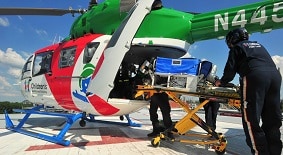
Our trucks don't look like normal ambulances. They are literally mobile ICUs with all of the equipment on there that you would need to provide really ICU level of care. There are ventilators, suction, all of the gases. We have technology to run lab testing, but I would say that the most important thing on those trucks is actually the crew, right? So, Julie spoke to this already, a highly trained skilled registered nurse who has a lot of experience before she ever came into the Transport department. She would have a partner on that truck that's an advanced paramedic who has been trained and is highly skilled and they have to have a lot of experience to really even qualify to come into this department. We have continuous communication with physicians at Children's to manage the care of that patient. And I think that's a really big thing. It's the level of care that we're able to provide from the minute we get to the patient. That patient becomes a Children's patient when we get to them, not when they get to our facility. So, Julie, the medic, our medical control physicians all start managing care at the outside facility and for the duration of that transport in.
I'll use the cliche that we use in pediatrics, children are not small adults. How we specifically manage a child's care can be really meaningful during that period of time. So, to know that no matter how far away that child is, we can take children's services to them and start that care faster while we get them to our facility is really important.
Lynn Smith: And I would imagine there's no typical day, kind of like Krystal described, this is not something where you walk into the office and it's mundane. There's always something new, but how often do calls come in and how do you decide if you're going to have a ground crew or flight crew? How many calls are you getting each day, week, and year?
Rana: Children's Transport receives anywhere from 10 to 40 calls per day. It varies where our trucks are, whether our aircraft is up, on how many of those calls that we can actually go to. How we decide is really based on logistics. There's only so many trucks and helicopters that Children's has. The decisions are made based on the acuity of the patient. We definitely want to make certain that our service is available for the sickest children that absolutely need us to be there to transport them for safety reasons. And then the decision between aircraft and ambulance, that oftentimes is made based off of patient acuity or distance, because we'll absolutely want to use our helicopter preferentially the further away the child is, just so that we can get to them quicker.
Lynn Smith: I want to go back to season one because we actually did an episode on this podcast about a child who seemingly out of the blue suffered cardiac arrest at school. He was flown on one of your helicopters from the Columbus area to Egleston. And at the time, it was so critical, if I remember correctly, that the flight team actually received clearance to fly a path that crossed through Hartsfield- Jackson airspace. Can you help us understand how that might happen and what communication takes place when something like that goes on? It's kind of similar to when you're dealing with the logistics of weather, I would imagine.
Rana: You know, we fly over Hartsfield-Jackson pretty regularly, but our normal pattern of flight over a large airport of that nature is that the flight team of the pilot immediately gets a clearance from Hartsfield-Jackson Air Traffic Control to pass over the airport. Under normal conditions, they'll tell them where exactly to pass over the airport is going to be on one end or the other of the runways. They fly a certain pattern, and they fly at an altitude that air traffic control tells them to fly.
Now, in cases where there are these significant emergencies and time is of the essence for us, our pilots can request a direct flight path over the airport. It's really touching when that happens, because what they'll do is they request the fly path. If granted, what Hartsfield-Jackson does is they actually stop all takeoffs and landings and put all aircrafts into a holding pattern that will allow the aircraft to go directly over the airport without any delays. The pilots struggle sometimes telling these stories, and they'll say it's really moving to them because all air traffic can hear that call, even the commercial flights. And it's not uncommon when that's happening to have a Delta flight say, “Hey, this is Delta flight 142. Godspeed, Children's one.” They know it's a child and it must be a really sick child in order for us to even ask that. Hartsfield-Jackson is amazing. They absolutely will prioritize someone's care in those cases, and they'll just put them in a holding pattern.
Lynn Smith: Can you tell us a little bit about the scope of the team? What's the flight team comprised of and the ground transport and also how many of these vehicles are in your fleet?
Rana: We actually operate nine critical care ambulances. They're very big, and they're very beautiful. You see Hope and Will going down the road. You know, it's a Children's ambulance. Little teaser here, we've ordered our first ambulance that's a different size coming soon. You'll see a slightly different size Children's ambulance on the road. We identified that because we spend a lot of time in the metro area, and so we purchased a bit of a smaller ambulance. It's just easier to navigate the Atlanta traffic that way. We actually have two helicopters that to the naked eye, if you didn't know helicopters, you wouldn't know the difference between them, but that allows us to always have an operating primary helicopter, and if we needed to service it for any reason, we won't have any downtime because we put them in a dedicated backup helicopter.
Lynn Smith: Describe the difference between how a Children's transport vehicle is staffed, whether it's flight or ground and other transport that would be on a typical ambulance that might reply to a 911 call.
Rana: Typically, when someone replies to a 911 call, that's going to be a two-person crew, and generally that crew will consist of the emergency vehicle operator or the driver, and that's typically an EMT, and then the person providing the clinical care in the back of that is either an EMT or a paramedic and that differs greatly. Obviously, from our crews, we do have an emergency vehicle operator who's also an EMT and then the clinical crew in the back is going to be a registered nurse and an advanced paramedic or respiratory therapist. So, minimally, in the back of our ambulances, you have two people who are going to provide care, and those are going to be a registered nurse and a medic or therapist, as opposed to just one person.
Lynn Smith: Rana, people will be surprised that a parent can ride in the back of a helicopter or ambulance. Can you talk to us about how that is possible and why it's important, and also why we try and do that whenever possible?
Rana: It's really important for us to try and keep parents with their children. We ideally don't want to separate parents from children. So, we do allow parents to ride in our trucks. We also allow parents to fly in the helicopter with us. Certainly, some key standards have to be met for that. They have to want to and be comfortable riding in a truck or a helicopter. For the helicopter, they have to be English speaking so that if any safety procedure were to take place, they would understand safety instructions, and they have to be calm. So those are really the main things, but it is ideal for us to make certain that we don't separate children from their parents.
Lynn Smith: In a recent episode here on the podcast, we talked about Move Day, and by that, I mean, Sept. 29, 2024. There's a big historic day when Egleston hospital will close and Arthur M. Blank Hospital will open all in a single day. How are you going to handle the logistics of this and involve the transfer of patients between these two hospitals?
Rana: You know what? We're super excited about Move Day and we're super excited about the Arthur M. Blank Hospital. At first pass, when you hear the daunting task of moving an estimated 300 patients in less than 12 hours, it feels pretty scary, but we will clearly have full operations of Children's Transport on that day. We will be entrusted to transport the sickest of those patients. Those that really need the high level of care and services that we provide in our ambulances. And then we've also got a couple of ambulance companies who will be providing 56 additional ambulances and crews in order to make this move happen.
Lynn Smith: I mean, it's just unbelievable. Julie, I want to get back to you. You're really one of these vital team members that Rana is describing for all of these types of things to go the way they go. You have one of the most important, but I would imagine really intimidating and nerve-wracking jobs. I'm curious, are there any stories that really stand out to you that give you that pride in the work that you do?
Julie: Definitely, this situation. That day really got me to realize how blessed we are in this area to have these resources. Seeing everybody's faces on that day made me realize that, well, this is it. I'm home.
Lynn Smith: Sure, and Krystal, I'm sure this is the same for you on the trauma side, that you know that your work is still going. What's saving lives and just from the trauma room in general, what kind of procedures are done in this type of room? How is it equipped differently than other areas in the emergency department that the trauma team and only the trauma team can perform?
Krystal: So, the Trauma room, or the Trauma bay as it may often be referred to as well, is significantly larger than the other ED examination rooms. There is x-ray capability in the room so that those critically-ill children do not need to leave the department to have x-ray imaging done. We do a number of procedures. They do central lines. The Neurosurgery team can place an EBD in a child in the Emergency room in the trauma bay. An EBD is an external ventricular drain. It is a device that is placed by Neurosurgery, and it is to drain Cerebrospinal fluid and also relieve intracranial pressure in the head. This is typically done for kids with head injuries. They do bedside ultrasounds. So, the room is, like I said, significantly bigger than a regular exam room. And it's designed that way so that all the necessary members of the team can be in the room and function at the same time without anybody being in each other's way. They have a whole cart set up for chest tubes in there because often our patients do need chest tubes.
Lynn Smith: You know, there are so many logistics that your team had to master so that we can all be sitting here talking about Kai's successful recovery. And speaking of which, Dr. Harris, can you tell us about how Kai's doing now, almost exactly one year after the injury?
Dr. Harris: He's great. He is as busy as he was then, actually. Yeah, he's great. He's cleared for all things, so we are back at it. Everything is 100%.
Lynn Smith: Dr. Harris and Dr. Washington, of course, our hope is that anyone listening to this never finds themselves in the situation that you were in, but should it occur, should they be standing outside the hospital room of their child, what do you want them to know?
Dr. Harris: It really felt like this huge embrace. I knew the Children's team was there. I felt very secure, even though it was an extremely insecure situation.
Dr. Washington: And another thing, just to echo that us as ER docs, we're probably already thinking Children's and the place is amazing. I mean, all the way down to the people that were cleaning up the ICU. I think every day the lady would ask me, “How are you doing? You holding up?” That's the EVS lady, you know, like everybody in that place is going to make you feel comfortable. They're designed to treat all angles and all the things that they're treating the family. That's what they're doing. They're treating the kid and the family.
Lynn Smith: That's exactly right. Because the parents need a certain amount of clarity in that chaos. And Rana, I just want to see if there's anything else you want to add to that.
Rana: You know, Dr. Harris and Dr. Washington, thank you. Thank you for trusting us with the care of Kai. We chose these professions out of a sense of calling, of wanting to be able to help others. You know, I feel eternally grateful that we were able to participate in Kai's care and certainly that Kai has had a really wonderful outcome and thank you for trusting us.
Dr. Washington: Thank you. Thank you.
Rana: You are so welcome.
Lynn Smith: It must feel really good, Krystal, Julie, Rana, to just hear how much you impact the lives of the children, also mom and dad.
Rana: You know, it's why we do this. It's what we come here for. I think every person can speak to this. These jobs can be emotionally draining, but these are the spaces that fill our cup, and these are the things that keep us going. So, thank you for the opportunity to see you guys and hear how Kai's doing.
Dr. Washington: Thank you
Lynn Smith: And with that, the second season of this podcast comes to a close. I cannot think of a better way to cap off a season full of meaningful conversations than with the harrowing and amazing stories that we heard today. I want to thank all of our guests. From our patient families to our specialized clinicians who brought this season to life with their shared experiences and insights. I also want to thank you, our listeners. You've made us a top ranked parenting podcast and also provided valuable feedback that helped shape everything you heard this season. So, keep the ideas coming because we will be back for season three. It's just in time for the 2024-2025 school year.
Until then, I'm Lynn Smith and I'm honored to join you in being part of Hope and Will, a parenting podcast from Children's Healthcare of Atlanta.
[VOICEOVER OUTRO]
This podcast is for general informational and educational purposes only. It is not to be considered medical advice for any particular patient. Clinicians must rely on their own informed clinical judgments when making recommendations for their patients. Patients in need of medical or behavioral advice should consult their family healthcare providers.
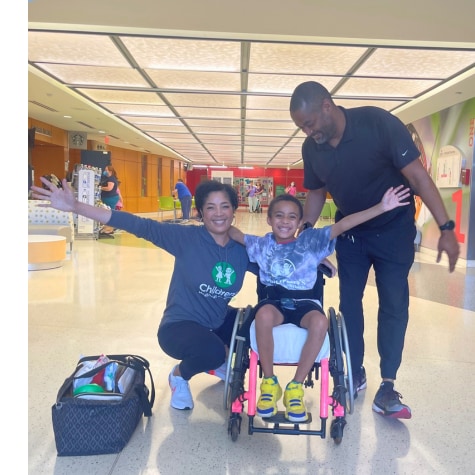
Dr. Jing Jing Wong Harris and Dr. Kevin Washington, Kai’s Parents
The Washington family’s world turned upside down when a neighborhood ride on an electric scooter resulted in a traumatic brain injury for then-6-year-old Kai. As experienced emergency medicine physicians, the doting parents found themselves in the unusual—and very challenging—position of straddling the worlds of hopeful patient family and informed clinicians. They share raw details of their experience, from riding in the back of a Children’s ambulance to watching our teams work their magic in from the emergency department to the PICU to the CIRU.
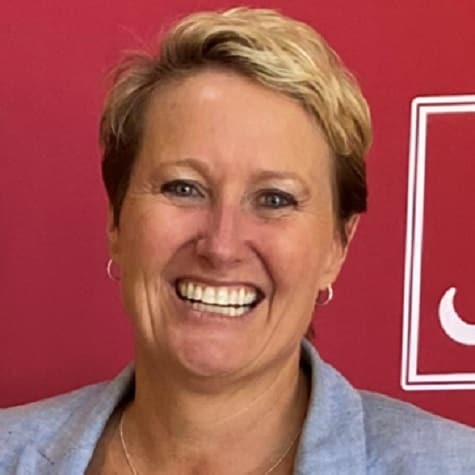
Rana Roberts, RN, Director, Children’s Transport and Trauma
Rana oversees our transport, trauma and transfer center teams, as well as the very busy call center that manages the dispatching of our emergency transport fleet. Having started her career at Children’s as a bedside nurse, Rana delights in opportunities to shine a light on the life-saving work carried out by her teams—and we’re proud that this episode does just that!
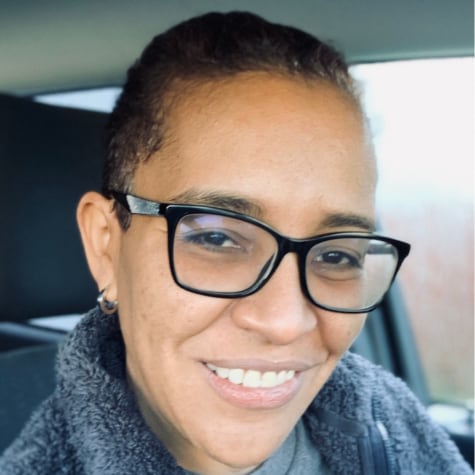
Julie Espinosa, RN, Pediatric Critical Care Transport – Ground
Julie was born in the U.S. Virgin Islands, where she worked as a paramedic for 13 years. Upon moving to Georgia, she set a career goal of working at Children’s. Julie fulfilled that dream in 2017 and feels fortunate to connect families to the depth of resources offered by our transport teams. At home, she’s the proud mom to a son who’s active in the Marine Corps and loves spending time with her granddaughter.
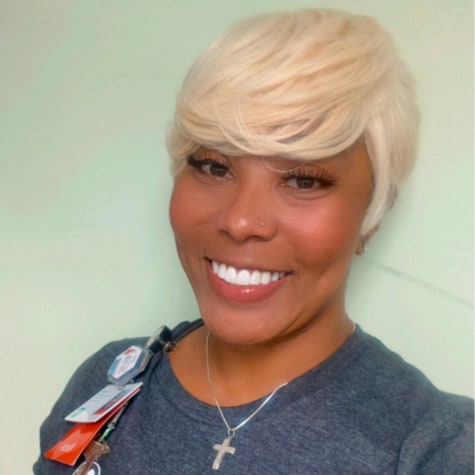
Krystal Harper, RN, Trauma
As a trauma nurse, Krystal brings 14 years of experience caring for kids who have suffered traumatic injuries, from motor vehicle accidents to bicycle impalements to falls from balconies. In her unique role, she helps ensure trauma patients receive seamless care, whether that’s in the emergency department, PICU or other patient care floors, from admission through discharge. At home, she’s a proud wife and mom to two young men.

Lynn Smith
Lynn Smith is a veteran journalist, podcast host and mom of two boys. Her experience as the parent of a patient at Children’s inspired her to advocate for spreading awareness of childhood illnesses and injuries.