Season 2: Episode 11
Hope and Will: A Parenting Podcast from Children's Healthcare of Atlanta
Golf Cart Safety: How a Casual Ride Led to the Fight of a Lifetime
Remember when hoverboards dominated news headlines? The skateboard-like toys quickly became popular around the holidays in 2015 and, just as quickly, started landing kids in hospitals with injuries.
While hoverboards got a lot of attention, there are other ride-on toys—ones that that might be in your driveway or garage right now—that regularly land kids in our hospitals and urgent cares, with injuries ranging from minor scrapes and gashes all the way up to serious head injuries. Toys like scooters, mopeds, bicycles and, yes, most especially ATVs and golf carts.
Our goal with this episode is not to scare you into getting rid of those toys or create fear around using them. Rather, as the weather warms and families head back outside, we share insight and tips to help keep your family safe and, most importantly, out of our hospital halls.
With golf carts rising in popularity as an easy way to commute around neighborhoods and short distances, we open with a story of a family who had used their golf cart daily for years before one quick tap on the brakes resulted in a harrowing flight on our helicopter.
Whether your kids are just now starting to use a balance bike or regularly grabbing the golf cart keys on their own, this episode has something for you.
Listen to this episode on your preferred podcast platform: Apple Podcasts, Spotify or Amazon Music.




Lynn Smith: As a parent, you may remember headlines about hoverboards. The skateboard like toys quickly became popular around the holidays in 2015 and just as quickly started landing kids in hospitals with injuries. While hoverboards got a lot of attention, there are other ride on toys, ones that might be in your driveway or garage right now, that regularly land kids in our hospitals and urgent cares, with injuries ranging from minor scrapes and gashes all the way up to serious head injuries. I'm talking about scooters, mopeds, bicycles, and yes, most especially, ATVs and golf carts.
Our goal with this episode is not to scare you into getting rid of those toys or create fear around using them. Rather, as the weather begins to warm and families head back outside, we want to share insight and tips to help keep your family safe, and most importantly, out of our hospital halls.
With golf carts rising in popularity as an easy way to commute among neighborhoods and short distances, we opened with a story of a family who had used their golf cart daily for years, before one quick tap on the brakes resulted in a harrowing flight on our helicopter. Whether your kids are just now starting to use a balance bike or are regularly grabbing the golf cart keys on their own, we're This episode has something for you.
It's my pleasure to welcome Amanda Moore to the show. It's also a pleasure to welcome you back to the show, Dr. Agarwal. You joined us last season for an episode about snake safety, where you'd shared some really, let's just say eye-opening insight about the prevalence of snake bites in Georgia and what to do if your child has been bitten by one. Amanda, Dr. Agarwal, thank you so much for being here.
Amanda, I just want to start with you because like previous guests on this podcast, you got that phone call all of us parents’ dread. And before we dive into that story and the reason you're here today, I want to get to know you and your family first. So, tell us a little bit about you guys.
Amanda: Well, we live in South Georgia. We're from the Warwick kind of Sylvester area. We're outside a lot, doing things like that. I'm a teacher. My husband works in construction. We're pretty busy all the time. We love being outside and doing outside things.
Lynn Smith: That's exactly what you were doing that day last summer. You were working as a teacher, I understand, in summer school, and your phone rings. Tell me what you heard and what was going through your mind.
Amanda: My son was with my mother-in-law and my husband. It was a nice day. They were out enjoying themselves. I got the call that he had fallen off of the golf cart, and he had after about 10 or 15 minutes thrown up. My mother-in-law, who is a nurse, felt like he possibly had a concussion, and we needed to go ahead and take him to the hospital. So, they started to the ER, and I was about 20 minutes behind.
Lynn Smith: And you're thinking to yourself, I'm sure, “What is going on? What's going to happen?” What were some of the warning signs that you noticed in Oren when you arrived at your local hospital?
Amanda: He was extremely lethargic. He did not respond to me when he saw me. For a 4 year old with their mom, that's very unusual. He just had no emotion. He wouldn't open his eyes for me. Probably about 15 minutes after I had been there, they started an IV on him. And he had no response to the IV whatsoever. He didn't cry. He didn't even feel it go to his arm. It was very scary. It was almost like he wasn't there.
Lynn Smith: And that led to you getting on a helicopter flight, having to go to Children's Healthcare of Atlanta. Can you explain to me what that flight was like? What was being communicated to you during the time?
Amanda: So that definitely already gives me chill bumps thinking about it. Our local hospital quickly decided after talking to Children's that we needed to come on up to Atlanta. They had seen some stuff on the CT scan that they wanted to go ahead and send us up for when we did get on the helicopter. We initially had to ride halfway in an ambulance because the weather was bad that day, and the helicopter couldn't get all the way down to the hospital. We rode to Macon where they picked us up on the helicopter. The ride to Macon was very scary. I just knew that he had a possible bleed and a fracture in the back of his skull. So, there were a lot of emotions, almost like in shock. You don't really realize how quickly something that dangerous can happen.
Once we got onto the helicopter, the nurses were amazing. They let me know that I would be able to ride with him. Once we got on the helicopter, they immediately started checking vitals, checking his blood, checking his pulse ops level, his eyes. I mean they were just on it on the way there. They were just constantly comforting me. “Mama, we've seen things like this before.” He was still very lethargic and was not really talking. He was just sleeping, so he missed most of the helicopter ride, but it was very scary for me. The nurses were so reassuring though that they had him and they were taking care of him.
Lynn Smith: Can you just describe how he actually fell off the golf cart? What exactly was going on and what prompted him to fall off?
Amanda: They were picking blackberries. We live in the South, and it was just that time of the year for blackberries to be out. He had gotten in the back of the golf cart because he was a little bit nervous about snakes. We were worried about the wrong thing.
He got in the back of the golf cart and whenever dad went to press the gas, it just flung him backwards off of the golf cart, and he hit the back of his head on the dirt road.
Lynn Smith: And initially, did he seem okay? And then how did things progress?
Amanda: He was crying very hard at first, which, you know, is expected. He just bumped his head pretty hard. Once we got him settled down, pretty quickly he got sleepy. It did not take long for him to get sleepy. He went to sleep and within five minutes he threw up. Everything that we saw happened very fast.
Lynn Smith: And that's when you knew you needed to get to that Emergency department. They then put you on that flight. You get to Atlanta. Tell me what happens from there.
Amanda: We got off the helicopter, and they walked us in and immediately there was a team of doctors and a team of nurses. There was a chaplain. There was someone there to take care of me. They walked in, they started cutting clothes off, doing all the things they needed to do, checking over the CT, checking all of his vitals again, checking his eyes.
At that point, he talked to them a very small amount, but they did get him to sit up and eat a popsicle. It was amazing because they were there for him, but they were also there for me. Once the team finished doing their evaluation, the doctor came in, and he talked to us. He said at the time that we got there, there was minimal swelling, and he wanted to continue to have minimal swelling for the rest of the time.
Lynn Smith: Can you describe for me how they articulated the diagnosis of exactly what was wrong and what they were going to do about it?
Amanda: We had Dr. Rubel there, who was amazing. He basically came in and told us that he had a pretty large fracture on the back of his skull. It went from the base of his skull, straight up the middle of his head, about midways. They said that part would heal like any child's bones would, but they were watching for swelling and continuing to make sure there was no bleeding. But they told us for the first 24 hours, they would be in every hour, checking his pupils, checking to make sure he was responsive in different ways. We also did two more CTs while we were there just to make sure that everything was staying like it needed to be.
Lynn Smith: Yeah, and we'll get to where Oren is now and how he's doing, but I just want to pause here and reiterate, your husband, your family, you're all very familiar with the golf cart. Oren's no stranger to riding the golf cart, right?
Amanda: No, it's something that we do on a daily basis, especially now. Golf carts are so prominent everywhere. Honestly, we were feeling like that was the safer version of an ATV to get. Whenever you think about it, that's what you think of, but unfortunately, anything can be dangerous.
Lynn Smith: Even when you're safety conscious, which I know that you were, but there was just something about the timing of that particular tap on the brakes and Oren's position on the golf cart at that moment that jolted him out of his seat and onto the pavement there. This is exactly why we're doing this podcast—the reminder for everyone out there that even when it's not your first time using a piece of equipment, even if it's something that's part of your daily routine, there are still risks there and there are precautions that need to be taken every time.
Dr. Agarwal, I want to bring you in because I know you weren't directly involved in Oren's case, but I'm pretty sure this is probably a story that's very familiar to you. Are you and your colleagues regularly seeing cases involving golf carts?
Dr. Agarwal: We're seeing about three children who have been injured on golf carts every month here in Atlanta. What we know is that nationally, there are a lot of children who are injured on golf carts and the number is increasing every single year, unfortunately.
Lynn Smith: So, tell me how that differs from ATVs because you heard Amanda talking about that. She thought this would be safer than ATVs.
Dr. Agarwal: So, ATVs have a lot more power and energy behind them. Those children tend to be more severely injured. And I think there's a lot of literature and guidance out there about keeping kids safe on ATVs, but when it comes to golf carts, that same level of information isn't out there. And we're finding younger kids are the ones who are injured on golf carts. In many instances, they are the passengers. So, on an ATV, you might have a child who's driving or riding that gets injured. But when it comes to golf carts, frequently it's a passenger, a child who just like in this situation has a caring adult who is driving the golf cart, and they fall off.
What we have to be mindful about is that golf carts are not tightly regulated, and they are not really designed with children in mind. So, things to think about children, small children especially can't necessarily brace their legs on the bottom of the golf cart. So, it's easy for them to fall over. We also know that young children have bigger heads, and so it makes them easier to be top heavy and to fall over, which applies to golf carts and a lot of other injuries that we see. Golf carts don't all have the same standard safety mechanism. Some have seatbelts, but some do not. And even if they do have seatbelts, they are designed for an adult.
Lynn Smith: And it's important to mention here that these are very popular in a lot of neighborhoods. Even in cities like Atlanta, you might see people riding to school and traveling between cul-de-sac to school. Short rides to nearby restaurants. I've seen people on a major road in a golf cart. So, in preparation for the discussion, we wanted to pull some data from the state of Georgia, and the numbers are really jaw dropping.
From 2019 to 2022 in Georgia, children ages 15 to 19 who were driving ATVs, golf carts, scooters, mopeds and other motorized recreational vehicles accounted for 943 injuries and 34 deaths. During the same period, children ages 0 to 17 riding as passengers in those vehicles experienced more than 1,500 injuries and 57 deaths. In just four years, nearly 2,500 injuries and 91 deaths in Georgia were linked to these recreational vehicles.
It's why we really wanted to make sure we give our listeners important information on how to prevent this because we also looked at some specific data from Children's Healthcare of Atlanta using metrics seen in your Emergency department at Egleston and Scottish Rite Hospitals, and in 2022 and 2023 combined, your teams cared for 225 ATV patients, 86 electric scooter patients, 84 dirt bike patients, 68 golf cart injuries, and 19 go cart injuries. And sadly, in 2022, Children’s also devastatingly saw four deaths. Two were related to ATVs, one golf cart and one dirt bike. Dr. Agarwal, when you hear these statistics, is it surprising to you?
Dr. Agarwal: It's really not surprising to me, sadly. What we know from research and just talking to people in the community is that we are encouraging children to be outside and to be more active. It's important for their health. We also know that children have been outside a lot more in the context of the COVID-19 pandemic. So, children wanted to burn off their energy, they don't have the same organized sports, so they're getting bicycles. They're getting scooters, some of them are getting ATVs, and we saw across the country more and more children being injured by these mechanisms.
Lynn Smith: And that's why we wanted to do something like this. We did a podcast episode with your colleague, Dr. Mark Griffiths, who's also a Pediatric Emergency Medicine Physician, and I remember him sharing a mantra that he shares with his own kids. It basically is, if it has wheels, you have to have a helmet. Can you tell me about the role helmets should play in all of this? I know if I told my kids to put a helmet on going in the golf cart, they'd look at me like I had two heads. So, can you give us an idea of what kind of safety precautions we should put into place?
Dr. Agarwal: Helmets are definitely recommended for a lot of these activities, things like ATVs, hoverboards, bicycles and scooters. The American Academy of Pediatrics released a statement on the importance of wearing helmets. I helped co-author that, and it's super-duper important. We don't have guidelines necessarily about helmets and their use when a child is in a golf cart. Helmets play such an important role though in protecting against brain injury if a child happens to fall. They are most well studied in children who are on bicycles, but what we know is that the use of an appropriately fitting helmet can reduce the risk of significant brain injury by up to 80%, depending on the paper that you look at, and there's data supporting the use of helmets for scootering, for snow sports—something that's not wheeled—but you should wear a helmet. And then even for horseback riding, again not a wheeled sport, but something where you need to think about wearing a helmet.
Another fact about helmets that I really like to use when I'm talking to families and especially kids about the importance of wearing a helmet, they not only protect against brain injury, they also prevent significant facial fractures and facial lacerations. That last key point sometimes really seems to resonate with the older kids who are really focused on maintaining their appearance. Sometimes that's what actually gets them to wear their helmet a little bit more.
Lynn Smith: And it's also not just checking the box of wearing a helmet. You really do have to make sure it's the right size and that it's on properly. What kind of information can you give us on that?
Dr. Agarwal: So first and foremost, you need to make sure that you're using the right helmet. There are different standards for helmets based on what activity you are engaged in. And so, you want to make sure that that helmet is designed for whatever you might be doing horseback riding, skating, etc. There are some helmets that are meant to be used for multiple activities. But again, you want to make sure it's the right one because a fall when you are horseback riding is different than a fall when you're on a bicycle, which is different than a fall if you're on an ATV.
You also want to make sure that that helmet is in good condition and not too old. The way a helmet works is similar to a car seat. When you have an impact, there are materials internal to the helmet that are meant to absorb that force, that energy, to reduce what's transmitted to the head and to the brain. If your helmet is too old, just like a car seat, that internal component can be degraded and not work as well. And, if that helmet has been in a crash before, it's done its job, just like if a car seat's been in a crash, those internal components that are meant to absorb the force may be used up and not as effective as before. So again, you need to make sure it's the right helmet. You need to make sure it's not too old. You also need to make sure that it hasn't been damaged.
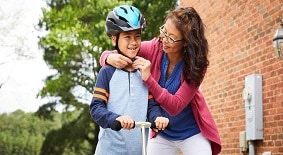
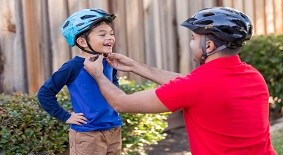
The final piece of this is to really make sure that helmet is fitting properly. So, I will go out in public all the time and I will see kids and parents wearing their helmets. Yay. That's awesome. But then you see the kid's helmet is all the way back, and you can see their beautiful curls at the top of their hairline or the chinstrap super loose, or they turn to look at their parent, and the helmet totally shifts. That helmet isn't really going to do its job. So, you need a snuggly fitting helmet.
The other big thing I like to do, especially with my oldest child, when she's getting ready to go ride on a bike or scooter is I like to make her do a little silly dance. It's a fun way to see if her helmet moves too much. If the helmet is shifting more than an inch in any direction, if it is falling into her eyes or shifting back so I can see her hair, then I know that I don't have it on right, and I need to adjust it. And I'll tell you, I get into arguments with her because she'll say, “Oh, it's tight. It's uncomfortable. I don't like this.” And I say, well, “Then you're not going to get on your bike. You're not going to get on your scooter today. That's it. Those are the rules.
So, I'm pretty strict about that with her.
Lynn Smith: Yeah, as you should be, as we all should be, because we know how safe they are. You mentioned that you were the senior author on the research article published last year about helmets, and it's surprising to me that there was a trend of less helmet use post pandemic. Can you tell us about that?
Dr. Agarwal: So, in a study looking just at Children's Healthcare of Atlanta patients, we found that in the context of the pandemic more and more kids were engaging in these amazing outdoor activities that we want them to do, but they weren't doing a good job of wearing helmets. I think part of that is that we maybe don't do enough education as we're encouraging kids to be outside to engage in these activities. We really need to fix that. We really do need to be talking about helmets all the time. And I really wish that every single time a store or online retailer sold a device where really a helmet should be used, they reminded the families like, “Hey, do you have a helmet?”
I can't tell you how many times I see kids in the Emergency department who are riding a bike or scooter, or they've been on an ATV or something like that. I asked them, “Were you wearing a helmet?” And they say no. And then I asked them why not? And they tell me, “I don't have one.” And that's just so sad and heartbreaking to me. These things really need to go hand in hand together every single time.
If your child is refusing to wear a helmet, involve them in picking out the helmet. Take them to the store. Have them look online with you to figure out what model they want. My daughter has an Elsa helmet that she adores, and that's why she's willing to wear it. Sometimes people will also use stickers with their kids to decorate the helmet to get them motivated to actually wear the helmet when engaging in these activities.
And then the other thing to consider, just being mindful that people have different types of hair, is to think about the hairstyle your child is wearing when they are engaging in an activity where they need to wear a helmet. I like to wear buns, but if I'm going to get on a bicycle, I have to make sure I'm wearing a low ponytail, low braids or a low bun.
Lynn Smith: Let's go through the toys and vehicles we've discussed to hear what tips you have for each specific one. Let's start with ATVs.
Dr. Agarwal: So, there is an entire policy statement focused on ATV safety for children and the American Academy of Pediatrics recommends that you don't let your child get on an ATV period under the age of 16, until they are licensed. Now, I grew up on a farm, and we definitely had an ATV. I recognize that they're fun and that for a lot of families that's just not going to be reality for them. So, they do have some other recommendations to reduce the risk of injury on an ATV. So, first and foremost, you want to make sure that your child is wearing a helmet and any other appropriate protected gear. That means your kid isn't getting on an ATV wearing short shorts and a tank top. They really need to have their skin protected as much as possible.
You also want to make sure that your child is appropriately supervised. And I think that's key for many of these injury mechanisms that we're talking about. There is no substitute for adult supervision. You want to make sure that your child is not riding with passengers. We know that passengers increase the risk of rollovers and injuries on ATVs.
You also want to make sure that you are thinking about where your child is riding. ATVs are meant to be driven on uneven surfaces. Actually, getting your kid on an ATV on a road increases the risk of injury. They're going to go at a higher speed. The vehicle becomes more unsteady, and they can very easily flip over. We also talk about making sure that children have formal training, if possible. There are formal training programs here in Georgia so children and families can learn how to ride an ATV safely. We talk about using speed limiter settings so most ATVs will have something on there saying you can't go beyond 15, 20 miles per hour, and then we also talk about making sure that they're highly visible so don't let them drive at night and also make sure that they have an orange safety flag. So, lots of recommendations as far as making ATV riding safer. But again, the primary recommendation is to try to stay off them.
The other thing I will mention about ATVs is the ATV we had on our farm growing up was a three wheeled ATV. And I know that they're still lingering out there in some homes, but they have been banned for decades now because they are really dangerous. So, if you come across a three wheeled ATV, get rid of it.
Lynn Smith: So, what about electric scooters?
Dr. Agarwal: Electric scooters are interesting. Again, it comes to helmets and adult supervision, but I also think people really need to be mindful if their child is getting on them. Here in the city of Atlanta, we have a lot of these e-scooters that people are getting on and can rent very easily to ride on the Beltline or any other pathway. So, making sure you're talking with your kids like, “Hey, if you're getting a rental e-scooter, you still need to wear a helmet.”
Lynn Smith: And then finally, golf carts, the reason that we're here talking. What are we supposed to do in that situation?
Dr. Agarwal: I think the first and foremost thing is to be aware of the risks and to make sure you have appropriate supervision. I think that you need to make sure you're driving the golf cart at a reasonable speed. So, some of these injuries are with a caring parent, just like in this situation, but there are instances of kids getting injured in golf carts where it's their teenage friend who's driving, and they're speeding down the pathway to get to school. So, making sure you're going slow enough, making sure that you try to avoid major roads whenever possible, a golf cart versus a regular car or pickup truck. It's not a battle the golf cart's going to win. So, staying safe on designated pathways is important, too. If there are seat belts, definitely make sure you use them. And then also being mindful of driving carefully when situations might be precarious. So, things like. bad weather, going up a hill, taking a sharp turn. There are instances where someone will take a turn in a golf cart and someone falls off sideways or they're going too fast and they actually flip the golf court altogether. And then finally, we really recommend that anyone who's going to drive a golf cart actually be 16 years old and have some actual real life driving experience like a license.
Lynn Smith: We've talked a lot about motorized vehicles, but I know helmets are just as important for other common toys that have wheels. So, let's talk about bikes, skates, skateboards and things like that.
Dr. Agarwal: For those items, again, we recommend a properly fitting helmet at all times. And we already went over some of the tips to make sure that helmet is properly fitting, as well as making sure it's the right helmet for you for that activity. Supervision can be important, as well. And in this instance, it's not just supervision. It's also modeling the behavior that you want your child to have. There's research that shows that children are more likely to wear helmets if they see their adult caregivers wearing helmets, too. I can't tell you how many times I see families riding their bicycles in my neighborhood. The kids have on helmets and like, yay. And then mom or dad has their hair flowing behind them without a helmet. And I kind of think of it like seat belts or smoking. You don't tell your kid, don't smoke cigarettes and then puff away in front of them. You don't tell your child to wear seat belts but then drive in your car unbuckled. It's like this for so many safety things. Model the behavior you want your child to have and make sure you're doing it early, too.
Lynn Smith: Yeah, that's such a good point. Amanda, from your perspective, you know when things go wrong, all too well. So, what do you do differently now than before Oren's accident?
Amanda: Honestly, we did not hold a whole lot of value in a helmet. I grew up in the country; we did not have helmets a lot. Now we're very much, “You have to have a helmet on.” He's scared of the golf cart now, so most of the time he rides between two adults in the middle so that we're on both sides of him so we can grab on both sides of him or whatever if something happens. If we have bicycles, he has a scooter, he also even has the balance. We have a helmet on every time we get on one. I think a lot of parents think that's just an extra cost to buy a helmet along with a bicycle, but in reality, it could have maybe helped with the accident that he had. It had more of an impact on my husband as far as that goes. I think it really brought to him how quick something can happen even when you try and do everything that you can to prevent it.
Lynn Smith: So, what do you hope parents remember about your story?
Amanda: We were very blessed and very lucky to be able to come home with our child after a few days. And unfortunately, like you said with those numbers, not everybody is that fortunate. I think the biggest thing is that you can never be too safe. Whether your kids like it or not, one day they'll thank you for taking care of them and keeping them safe. It's worth the battle. Just fight it and make them put on the protective gear.
Lynn Smith: No matter how big the fight is, it’s worth it to save their little heads. Dr. Agrawal, you are a mom to three kids. You've seen so much in the Emergency department, and you've learned so much through your research and conference attendance and things like that. What is the advice? What are three of the most important things you want parents to remember from this conversation?
Dr. Agarwal: I want them to remember the importance of a helmet, and not just a helmet, but an appropriate for the activity, not too old or banged up. Appropriately fitting helmet for their child. That is so, so, so important. You are the parent. You set the rules. If your child isn't going to wear a helmet, then don't let them have a bike. Don't let them have access to the scooter. You're the parent. parent. You set the rules. It's okay to set the rules. It's okay if your kid is angry at you for a day or so because it's their life. It's their health. And that's one of your main jobs as a parent and caregiver.
The second thing I want people to remember is that there is no substitute for supervision. That's so important whether your child is on a golf cart, whether they're on an ATV, on a bike, your eyes, or a pair of trusted eyes, there's no substitute for that. And that does relate to when your kid goes to a friend's house. Tell them what they're allowed to do and not allowed to do and enforce those rules. And then the third thing, model the behavior you want to see your kids engage in. So again, if you expect them to wear a helmet. You need to wear a helmet. If you expect them to never get on an ATV, you don't need to be getting on an ATV anywhere near them or letting them hear that you've been on one or something along those lines. You have to be the role model for your child. They are our role models. Always, always watching, and they will catch you doing all the things that you don't want them to see, and they will throw it right back in your face, hopefully in a cute way.
Lynn Smith: Just like you've had with your children, we've all had it with ours. Amanda, I want to end with you. How is Oren doing now?
Amanda: He's doing awesome now. He turns 5 in a couple weeks. He's awesome, but he's also very aware of things and how accidents can happen. He started pre-K this year, and he's thriving. He's doing great.
Lynn Smith: Oh, it's the greatest. And now, because of your story, and thank you for sharing it, hopefully parents listening will remember, it is safety first, and you have to think of the worst-case scenario sometimes to make sure that our little ones are protected. Amanda, Dr. Agarwal, thank you so much for being with us.
For more tips and resources to help prevent injuries in kids and teens, visit this episode's webpage at choa.org/podcasts. We will link to resources from our Strong for Life team that are meant to keep your family out of our halls.
I'm Lynn Smith and this has been Hope and Will, a parenting podcast from Children's Healthcare of Atlanta.
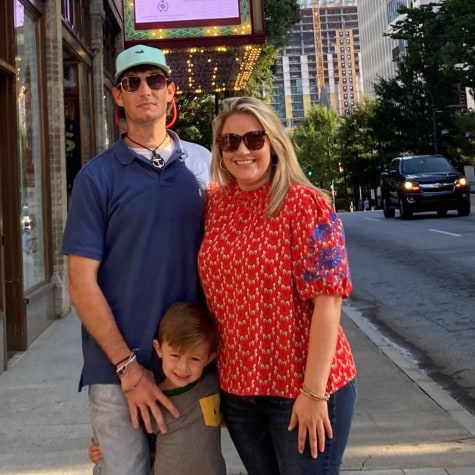
Amanda Moore, Oren’s Mom
While teaching summer school, Amanda got “the” call no parent wants to receive. Her 4-year-old son, Oren, had fallen off the back of a golf cart, landing headfirst on the ground. As minutes ticked on, he began getting drowsy and vomiting—telltale signs of a head injury. She needed to get to the local emergency department. And quickly. Amanda shares Oren’s story to raise awareness of the dangers of golf carts and other ride-on toys—even those with which families are very familiar.

Dr. Maneesha Agarwal, Pediatric Emergency Physician
At work, Maneesha Agarwal, MD, cares for sick and injured patients in our emergency departments. At home, she’s Mom to three kids. As a member of Children’s Injury Prevention Program (CHIPP), she is passionate about injury prevention. This is her second time as a guest on our podcast, having previously contributed to season one’s “Snakes in a Yard: How a Basketball Game Ended with a Copperhead Bite.”
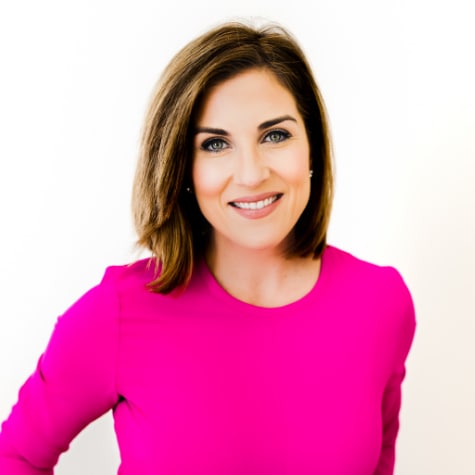
Lynn Smith
Lynn Smith is a veteran journalist, podcast host and mom of two boys. Her experience as the parent of a patient at Children’s inspired her to advocate for spreading awareness of childhood illnesses and injuries.