Myth vs. Fact: Treating Scoliosis Without Surgery
Not all kids and teens with scoliosis will need surgery—in fact, most kids and teens who come to Children’s for spine care won’t need spine surgery at all. Learn more about the different types of nonsurgical treatment that our spine specialists might recommend for your child’s scoliosis care and learn why dedicated pediatric care makes all the difference.
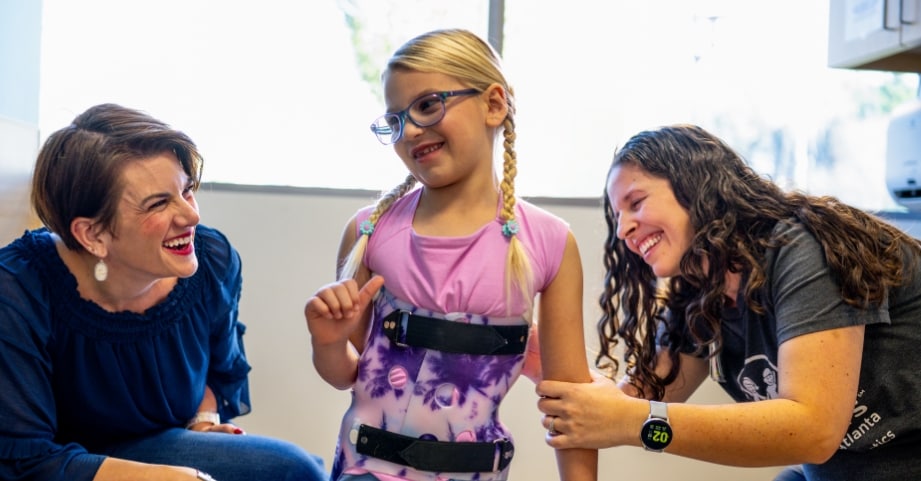
Myth: Surgery is always the best option for scoliosis treatment.
Fact: Scoliosis, or a sideways curve of the spine, can often just be monitored as a child grows to make sure it doesn’t progress. In some cases while a child is still growing, there are treatment options that help stop a child’s curve from progressing further until they are finished growing. While these methods do not reverse scoliosis, or improve a child’s curve, they can keep a child’s curve from getting worse with the goal of avoiding spine surgery. With early detection, your child’s doctor may have more time and opportunity to treat scoliosis without surgery.
Who might benefit from nonsurgical scoliosis treatment?
Your child’s treatment will depend on the kind of scoliosis, size of the curve and how much they are likely to grow. The goal of treatment is to stop or minimize the progression. For older kids and teens whose curvature is minor, or who have little growth remaining, there is very little progression. Younger children who are still growing may have the highest risk of progression.
A scoliosis or spine brace is often worn to slow or stop scoliosis from progressing while a child is still growing. With spine bracing, the hope is to keep the curve minor enough to prevent the need for surgery.
Myth: Any back brace available online or through a chiropractor’s office is sufficient for scoliosis treatment and prevention.
Fact: In some cases, scoliosis can be treated with a custom spine brace. Spine bracing for scoliosis is used to help prevent curves in the spine from getting larger as your child grows. Unlike a typical back brace you might buy from a chiropractor or online retailer, a spine brace for scoliosis is uniquely designed for your child. When worn correctly and for the prescribed amount of time, it applies pressure to the spine to keep the curve from worsening, and it can be adjusted as your child grows. In Georgia, only licensed orthotists are legally allowed to design and fit custom scoliosis braces.
Our team of spinal orthotists is experienced in a variety of spine braces and in working with children dealing with spine conditions who may need a brace or a cast. Whether your child is prescribed a brace to wear consistently throughout the day and night, or just at night, it’s important to consider their comfort. Our spine team is here to help make adjustments along the way, and to offer support and tips for wearing a scoliosis brace.
Just like bracing, the goal of scoliosis-specific exercises like Schroth therapy is to prevent curve progression as a child grows.
Myth: Seeing a chiropractor or physical therapist consistently for pain will reverse my child’s scoliosis.
Fact: While chiropractic care and traditional physical therapy can be effective at decreasing pain associated with scoliosis, bracing and scoliosis-specific exercise is the gold standard for slowing or reducing curve progression without surgery.
“Just like bracing is customized to the child and their specific curvature, so is physical therapy that is specific to slowing or reducing scoliosis,” says Kristen Sagan, PT, DPT, a Pediatric Physical Therapist at Children’s. “If a family wishes to have a chiropractor or a physical therapist without specialized training on their care team, look for one who is willing to work with your orthopedist, orthotist and scoliosis-specialized physical therapist.” While chiropractic care, under the guidance of a licensed pediatric orthopedic specialist, can be part of your child’s overall care plan, bracing and physical therapy with certified professionals should be your child’s primary line of defense in keeping your child’s curve from worsening.
How can Schroth therapy keep scoliosis from getting worse?
Schroth therapy works by using posture and muscle training to reduce uneven “loading” (or stress) on the spine. While bracing works to correct the spinal curve progression passively, Schroth physical therapy works on correction actively, through exercise, strengthening and stretching.
The exercise program for Schroth-based physical therapy (PT) can be intensive, and it is recommended that parents or caregivers work with their child at home four to six times per week. This physical therapy may look a bit different from typical PT, often using straps and unique positioning, and sometimes involving your child’s brace. Throughout this process, you will still be seeing your regular physical therapy team once or twice a week initially, and they will help answer any questions or address any concerns you may have about your home exercise program.
No matter how intensive your child’s physical therapy needs may be, our team is here to walk you through every step of the process. Our goal is to help make sure that you feel safe and comfortable guiding your child’s care at home.
As Georgia’s only nationally ranked Orthopedics Program for kids and teens*, Children’s is a leader in orthopedic and spine care. Our team of pediatric orthopedic specialists—including doctors, orthotists and physical therapists—are specially trained to treat children, teens and young adults with scoliosis. Most patients and families want to avoid spine surgery if they can, and our team of spine specialists focus on evidence-based treatments to help prevent scoliosis from worsening. Our goal is to save surgery as a treatment option if other, more conservative treatment methods aren’t enough to stop your child’s scoliosis from progressing.
At Children’s, we know that the scoliosis journey can be a long one. Consistently ranked among the best children’s hospitals in the country by U.S. News & World Report*, our team works closely with specialists from across the country and around the world to help establish best practices for pediatric spine care.
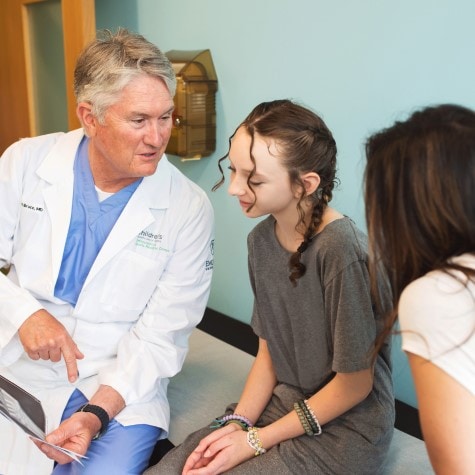
Go to Children’s for That
Request an appointment with the only nationally ranked orthopedic program for kids and teens in Georgia, and we’ll help you understand your child’s diagnosis and create a comprehensive treatment plan.
Make an Appointment


C. Leigh Davis, MSPO, CPO, FAAOP, is an Orthotist and Prosthetist at Children’s Healthcare of Atlanta. She has been at Children’s for more than 15 years. She attended Georgia Institute of Technology and earned her master’s in prosthetics and orthotics. Leigh’s clinical area of interest includes orthotic treatment of idiopathic scoliosis.
Kristen Sagan, PT, DPT is a physical therapist and clinical supervisor in the rehabilitation department at Children’s Healthcare of Atlanta. She is a Board-Certified Clinical Specialist in Pediatric Physical Therapy and has been at Children’s for 16 years. She earned her undergraduate degree from the University of Georgia followed by her Doctorate in Physical Therapy from Emory University. Kristen discovered her passion for treating scoliosis during her pediatric residency and went on to complete additional training and certification in scoliosis specific exercises through the Barcelona Scoliosis Physical Therapy School.
This content is general information and is not specific medical advice. Always consult with a doctor or healthcare provider if you have any questions or concerns about the health of a child. In case of an urgent concern or emergency, call 911 or go to the nearest emergency department right away. Some physicians and affiliated healthcare professionals on the Children’s Healthcare of Atlanta team are independent providers and are not our employees.
*No. 9 on the U.S. News & World Report “Best Children’s Hospitals” list for 2025-26.