What to Know About Torticollis in Infants
Children’s Healthcare of Atlanta is a leader in cranial remolding and the treatment of infants with congenital muscular torticollis. Learn how to detect early signs of torticollis, and how the trusted specialists at Children’s can help care for your child.
Congenital muscular torticollis (also called CMT or wry neck) is a tilting of the head to one side or another due to a shortening of muscles in the neck. The word torticollis means “twisted neck,” and it is most often caused by a tight muscle on one side of a child’s neck, limiting their head motion. While congenital generally means a condition was present at birth, torticollis may occur within the first few months of life. This can often lead to a flattening of one side of the head, referred to as plagiocephaly.
Children’s offers specialized care from an experienced pediatric team. If you or your pediatrician suspect your baby should be evaluated for CMT or plagiocephaly, our Cranial Remodeling Program is here for you every step of the way.
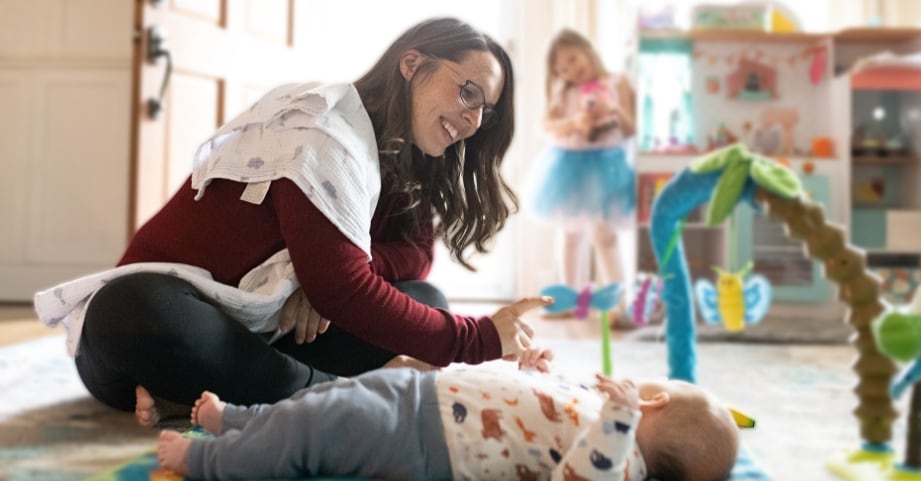
What Are the Early Signs and Symptoms of Torticollis?
Pediatricians and parents should be screening for torticollis between the first 24-72 hours of birth, looking for difficulty turning the head in one direction vs. the other. Some early signs and symptoms to be aware of include:
- Preference to look more towards one side than the other when positioned on back or belly.
- Preference to feed from one breast more than the other.
- Flattening on one side of the head.
- Facial asymmetry (cheeks or eyes may appear as two different sizes).
- Redness or irritation in the lateral (horizontal) skin folds of the neck.
Some babies may be at higher risk for developing torticollis and would benefit from an evaluation with a physical therapist for close monitoring of signs and symptoms of torticollis. Some factors that may make a baby at risk include babies who are:
- Large for gestational age (high birth weight and length).
- Breech position.
- Diagnosed with hip dysplasia or brachial plexus injury.
- Multiples (twins, triplets, etc.).
- Subject to birth trauma, including the use of forceps or vacuum.
- Identified as having a history of neonatal abstinence syndrome.
Is Torticollis Reversible?
Torticollis can be reversible, and parents and caregivers can help improve their child’s condition with a home exercise program (HEP). “Stretches and the HEP should be completed several times throughout the day for best results,” says Jill Cannoy, a Physical Therapist at Children’s Orthotics and Prosthetics Program. “Tummy time is also key. I tell families to do their stretches at every diaper change, as this is a good reminder of when to do these activities." A physical therapist can also teach you ways to position and feed your baby to help promote active and passive stretching.
The most important thing to keep in mind is that physical therapy should be started as soon as asymmetries or a side preference is observed. When these exercises are started earlier, it can shorten the amount of time spent in physical therapy.
Torticollis is typically treated first with physical therapy and in many cases, physical therapy is enough to correct torticollis before it becomes more serious. In some cases, further interventions or referrals for cranial remolding may be necessary.
“The first line of defense should be physical therapy,” explains Jill. “Physical therapy should focus on range of motion, including stretching and strengthening, while educating caregivers on how to facilitate these activities, as well as symmetrical movements and repositioning.”
Physical therapy should include both passive and active cervical range of motion stretching. Passive stretching involves a parent or caregiver using their hands to guide the baby’s head, neck and shoulders, and turn their head. Active stretching encourages the baby to stretch and strengthen on their own, with the caregiver providing support and guidance.
Children’s is a leader in cranial remolding and the treatment of infants with congenital muscular torticollis. Our team co-authored the 2024 Clinical Practice Guideline Update for torticollis, which are the treatment recommendations for physical therapists across the country who are treating infants with torticollis. Often, torticollis can lead to other developmental asymmetries along with a flat head, including plagiocephaly. Our Plagiocephaly Severity Scale was published in the Journal of Craniofacial Surgery and is accepted internationally as the standard of care.
In addition to contibuting to the treatment recommendations for torticollis and cranial remolding for infants with plagiocephaly through our research, we also present at medical meetings nationally and internationally so that families around the world can benefit from the standard of care created at Children’s.
As the only nationally ranked Orthopedics Program for kids and teens in Georgia*, our team of specialists is here to guide you and your family through evaluation, diagnosis, treatment and beyond.
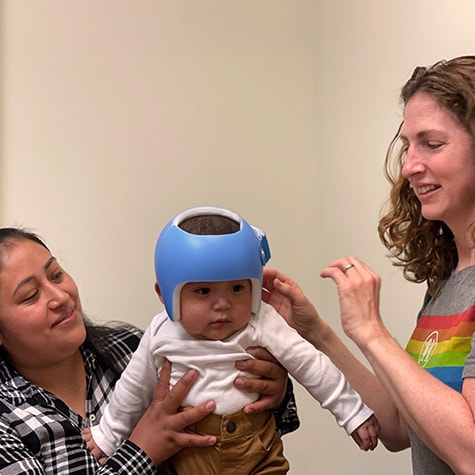
Go to Children’s for That
Children's performs evaluations and initial scans for flat head syndrome at no cost, and most insurance plans are accepted. We have seven locations across metro Atlanta for assessment and treatment.
Find a Location

Jill Cannoy is a pediatric physical therapist at Children’s Healthcare of Atlanta. Jill serves as a faculty mentor within the Children’s Pediatric Physical Therapy Residency Program and serves as the lead physical therapist for the Children’s Limb Deficiency Program. Jill received the 2021 American Physical Therapy Association (APTA) Georgia Outstanding Physical Therapist Award and the 2022 Clinical Excellence Award from APTA Oncology. Jill's areas of interest include pediatric cancer rehabilitation and pediatric limb differences and deficiencies. Jill has presented at the local and national level and has been published in the Journal of Pediatric Physical Therapy, Rehabilitation Oncology, and Tecklin's Pediatric Physical Therapy.
This content is general information and is not specific medical advice. Always consult with a doctor or healthcare provider if you have any questions or concerns about the health of a child. In case of an urgent concern or emergency, call 911 or go to the nearest emergency department right away. Some physicians and affiliated healthcare professionals on the Children’s Healthcare of Atlanta team are independent providers and are not our employees.
*No. 9 on the U.S. News & World Report “Best Children’s Hospitals” list for 2025-26.