How to Avoid Medication Mistakes With Your Kids and Teens
Just because your kids have a cough, sniffle or sneeze, doesn’t mean they need over-the-counter medication. Parents need to be careful not to make mistakes when it comes to giving their kids and teens medicine at home. And as we see new and dangerous social media challenges aimed at kids and teens, it’s becoming more important to make sure your medications are stored correctly too.
Store medications out of sight and out of reach
According to a report from safekids.org , kids and teens often find medicine, in pillboxes, on the ground, inside a purse or diaper bag, on reachable counters and cabinets, or in the refrigerator. While many common over-the-counter medicines—like acetaminophen (Tylenol), ibuprofen (Motrin) or Children’s diphenhydramine (Benadryl) — and prescriptions have safety caps on them, they’re not child-proof.
The best thing you can do is store over-the-counter and prescription medicines out of reach (preferably high up) and out of sight.
Here are some additional tips for safely storing medications:
- Keep all medications in their original packages. In one study, it was found that 51.5% of participating unsupervised solid dose medication exposures involved medication that had been previously removed from its original packaging.
- Store medication in a small lockbox or safe.
- Place medications back in safe storage immediately after using them.
- Never leave medication out in an area with a child. If you must step away, take the medication with you.
- Talk about how to safely store medication with other grown-ups who spend time around your kids (e.g., grandparents, friends, loved ones and babysitters) to help prevent them from making medication accessible.
- Dispose of unused or expired medications at healthcare facilities, local “take back” programs or your nearest drug disposal location.
- Remember to store products you might not think of as medication, such as vitamins, diaper rash creams or eye drops, safely too.
It’s natural for parents to feel nervous when their toddler or child is cranky and feels a little warm, and it can be tempting to hope that an over-the-counter fever reducer will solve everything. But you should be careful not to give your children medicines that they don’t need.
“We want parents to think twice before automatically giving their children over-the-counter medication like a liquid fever reducer when they think their child has a high temp,” says Stephanie M. Jernigan, MD, a Pediatric Nephrologist and Co-Chief of Medicine at Children’s Healthcare of Atlanta. “That’s because it’s easy to give a child too much medicine, and the consequences can be serious—even fatal.”
In the U.S., thousands of children visit emergency departments every year for problems related to medication reactions and errors in giving medicine at home.
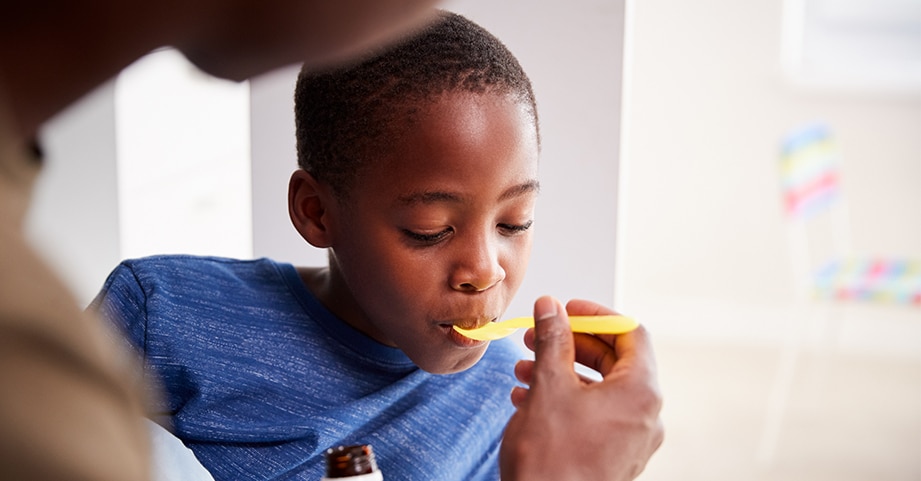
Many parents unwittingly give their kids the wrong dose of liquid medicine—in some cases, more than twice as much as instructed.
One study funded by the National Institutes of Health (NIH) found that more than 80% of parents made at least one dosing error when dispensing liquid medicines and that 68% of the errors were overdoses. The study also found that most errors occurred even when parents used a measuring cup. There were fewer errors when parents measured the dose with an oral syringe, the method recommended by doctors.
Reference the charts below to make sure you’re giving your child the right medication dosage.
Acetaminophen dosage
| Child's weight | Infant or children’s liquid* (suspension) | Meltaways | Junior meltaways | Dissolve packs | |
|---|---|---|---|---|---|
| Pounds (lbs) | Kilograms (kg) | 160 milligrams (mg) per 5 milliliters (mL) | 80 mg tablet | 160 mg tablet | 160 mg** |
| 12 to 17 lbs | 5.4 to 7.7 kg | 2.5 mL | Do not use | Do not use | Do not use |
| 18 to 23 lbs | 8.1 to 10.4 kg | 3.75 mL | Do not use | Do not use | Do not use |
| 24 to 35 lbs | 10.9 to 15.9 kg | 5 mL | 2 tablets | 1 tablet | Do not use |
| 36 to 47 lbs | 16.3 to 21.3 kg | 7.5 mL | 3 tablets | 1.5 tablets | Do not use |
| 48 to 59 lbs | 21.8 to 26.8 kg | 10 mL | 4 tablets | 2 tablets | 2 packets |
| 60 to 71 lbs | 27.2 to 32.3 kg | 12.5 mL | 5 tablets | 2.5 tablets | 2 packets |
| 72 to 95 lbs | 32.7 to 43.1 kg | 15 mL | 6 tablets | 3 tablets | 3 packets |
*You may see the word “suspension” on your child’s medicine bottle. Shake the medicine well before giving it to your child. Use the syringe or medicine cup that comes with the medicine. Do NOT use a kitchen teaspoon or tablespoon to measure your child’s medicine.
**Make sure the box of dissolve packs says "Children's Tylenol for Ages 6-11" and NOT adult.
| Child's weight | Infant's drops* | Liquid suspension** | Junior chewable tablet | |
|---|---|---|---|---|
| Pounds (lbs) | Kilograms (kg) | 50 mg per 1.25 mL | 100 mg per 5 mL | 100 mg** |
| 18 to 23 lb | 8.1 to 10.4 kg | 1.875 mL | 3.75 mL | Do not use |
| 24 to 35 lb | 10.9 to 15.9 kg | 2.5 mL | 5 mL | Do not use |
| 36 to 47 lb | 16.3 to 21.3 kg | Do not use | 7.5 mL | 1 ½ tablets |
| 48 to 59 lb | 21.8 to 26.8 kg | Do not use | 10 mL | 2 tablets |
| 60 to 71 lb | 27.2 to 32.3 kg | Do not use | 12.5 mL | 2 ½ tablets |
| 72 to 95 lb | 32.7 to 43.1 kg | Do not use | 15 mL | 3 tablets |
* Use the dropper, syringe or medicine cup that comes with the medicine. Do NOT use a kitchen teaspoon or tablespoon to measure your child’s medicine.
**You may see the word “suspension” on your child’s medicine bottle. Shake the medicine well before giving it to your child.
Read more about the proper dosage of popular over-the-counter allergy medications.
Follow along to learn how to properly give your child medicine, making sure you’re giving them medication safely and accurately.
For over-the-counter medications:
- Think twice. Before you reach for an over-the-counter medicine, make sure your child needs it. In many cases, medication isn’t needed for a quick recovery, especially with cases of the flu or a common cold. If you’re unsure whether your child’s symptoms need medication, it’s always best to check with their doctor.
- Read the directions first. Follow the exact directions and dosage recommendations for weight—rather than age—printed on medication labels.
- Check active ingredients. Read the active ingredients to avoid an accidental overdose. Don’t give a child acetaminophen (Tylenol) or ibuprofen (Advil) when they are taking other medications that may also contain either. This includes over-the-counter cough and cold medicines.
- Know the daily dose. Always ask your physician or pharmacist what the maximum daily dose is for your child (based on their age and weight). Over-the-counter cough and cold medication is not recommended for kids under 6 years old due to side effects.
- Be patient. It may take 60 to 90 minutes for these medicines to work. The temperature may not return to normal, but it should get better, which will make your child feel more comfortable.
- Check with your child's doctor. Acetaminophen should only be given to babies older than 3 months unless you have a doctor’s order. Ibuprofen should only be given to babies older than 6 months unless you have a doctor’s order.
- Give children's medication only. Never give a child an adult version of a medication.
- Check labels. Check the medication label for expiration dates. Expired medications can lose their strength and be harmful.
- Follow the guidelines. Measure the dose out exactly using only medication syringes or the dispenser that came with the product. If your medication doesn’t come with a dosing device, ask the pharmacist for one. If you’re having trouble reading medication administration devices, you can always ask your nurse or pharmacist.
- Be accurate. Never use kitchen spoons or cooking measuring spoons as substitutes—they’re not accurate.
- Never give a child aspirin or anything containing salicylates, especially when your child has a viral illness, unless it is specifically prescribed by your physician. Aspirin has been linked to Reye’s syndrome, a disease that can be fatal for kids.
It’s important to be extra cautious with prescription medications as well. Here’s what to look for:
- External factors matter. Make sure your pediatrician and pharmacist know your child’s weight, their allergies and all of the medicines their taking, including other prescriptions, over-the-counter medications, herbal products, vitamins, supplements or home remedies.
- Contact your doctor. If you have any questions regarding your child’s medications, such as how much your child can take, drug interactions and food interactions, don’t hesitate to ask your physician or pharmacist and voice your concerns.
- Understand the prescription. When your child’s doctor writes a prescription, make sure you can read it. If you can’t read the handwriting, your pharmacist might not be able to either.
- Check labels. When you pick up your child’s medicine from the pharmacy, make sure the label lists the medication your doctor prescribed and the proper dose.
- Ask about dosages. If you have a question about the dosage, always ask. For example, “Does ‘four doses daily’ mean every six hours around the clock or just during waking hours?”
- Finish the prescription. If your doctor prescribes antibiotics, be sure you give your child the full course, even if they appear to be better. Stopping antibiotics mid-course can give lingering bacteria a chance to grow back, resulting in the need for even stronger antibiotics.
Here are some more safety tips from our Children's experts:
- Use the appropriate dosage tool, whether a cup with an over-the-counter medication, or a syringe-like tool, to provide the most accurate dosage to your child. Do not use a kitchen spoon for a tablespoon or teaspoon measurement because spoon sizes vary and can cause errors in dosing.
- Share clear instructions with caregivers about your child's medication, including specifics on dosages and frequency.
- Never refer to medicine as consuming “candy.” This could be confusing to a child, which could tempt them to try other medications.
- Let your child know that only a trusted adult should give them medicine and that they should never take medicine on their own.
- Read your child's medication, drug facts and prescription labels thoroughly—especially over-the-counter medication. As your child becomes more independent, make sure they learn how to read and understand the label before taking medicine.
- Stress the importance of responsible medication behavior.
- Encourage pre-teens and teens to read labels and drug facts for over-the-counter medications and prescriptions before taking them. (And to make sure they’re taking the right medicine!)
- Stress the importance of only taking medicine that is designed to treat their illness or symptoms, and to only take medication meant for them. Medication should never be shared with others.
- Talk to your teen regularly about the medication they are taking and how to take it responsibly. Share that medicine labels are rules, rather than guidelines.
- Make sure your teen follows the recommended dosage and knows that taking more than the recommended dosage at a time could do more harm than good.
In addition to monitoring dosages, there are several things you can do around your home to keep a child safe.
Nearly 60,000 children are seen at emergency departments each year because they took a medicine they weren't supposed to.* This may happen when a toddler figures out how to open a medicine cabinet in the bathroom, a teen jumps on the latest dangerous social media challenge or if a parent doesn't explain medication dosages correctly to a caregiver.
A few things to be mindful of around the home:
- Store medicine properly. Store all medication out of children’s sight and reach. In 86% of emergency department visits for medicine poisoning, a child took medicine belonging to a family member.
- Reconsider where you keep your medicine. We often carry our medicine in purses or store it in nightstands, but kids can find them there. Place purses or bags out of reach, and avoid leaving medicine in or on a bedside table or dresser.
- Be mindful of other products, too. Consider products you might not think of as medicine. Health products, such as vitamins, diaper rash creams, eye drops and even hand sanitizer can also be harmful to children.
- Be clear with caregivers. They need to know what medication to give your child, how much to give them and when to give it to them. Using a medicine schedule can help communicate better with caregivers.
- Know the number. Save the local poison control center help number in your cellphone. You can also call 1-800-222-1222 to reach national poison control, who will put you in contact with your local poison control center.
Be sure to follow these guidelines the next time you fill a prescription for your child or pick up an over-the-counter medication, and don’t hesitate to ask for more information if you are even just a little bit unsure about what medicine is best for your child.
*Safe Kids Georgia, 2019
Immediately call the poison control center at 1-800-222-1222 if you believe a child may have gotten into medicine or vitamin or for any unintentional medication overdoses. They can provide guidance, including whether your child can be safely managed at home or needs to go to the emergency department.
If instructed to go to the emergency department, try to bring the product your child ingested with you.
Helping You Navigate Common Childhood Illnesses


This content is general information and is not specific medical advice. Always consult with a doctor or healthcare provider if you have any questions or concerns about the health of a child. In case of an urgent concern or emergency, call 911 or go to the nearest emergency department right away. Some physicians and affiliated healthcare professionals on the Children’s Healthcare of Atlanta team are independent providers and are not our employees.
Contact Us 404-785-KIDS (5437)