
A cochlear implant is a small, electronic device that helps provide access to sound to a child who is profoundly deaf or severely hard or hearing. It consists of two parts: a surgically implanted piece and an external piece worn on the head that resembles a behind-the-ear hearing aid.
How does a cochlear implant work?
A cochlear implant is different from a hearing aid, which amplifies sound so that it can be detected by remaining hair cells in the ear. A cochlear implant bypasses the damaged hair cells and uses electrical signals to stimulate the auditory nerve directly. A cochlear implant is made up of an internal component that is surgically placed inside the cochlea (the spiral-shaped part of the inner ear) and an external sound processor.
- External portion: This includes the microphone, speech processor and transmitting coil. The microphone picks up sounds, and the speech processor converts them into digital signals. The transmitting coil, which is held in place on the outside of the head with a magnet, sends the signals through the skin to the internal implant.
- Internal receiver: Surgically implanted beneath the skin, the internal receiver gets signals from the external device and sends them to the electrode array in the cochlea. The electrode array stimulates the auditory nerve, carrying signals to your child’s brain, where they’re interpreted as sound.
At Children’s, we are dedicated to meeting the needs of kids with profound hearing loss.
- Experienced pediatric team: Our team of otolaryngologists, audiologists and speech-language pathologists are pediatric trained and have experience working with kids from birth to age 21.
- Comprehensive services: We offer a full range of audiology diagnostics and treatment services, providing integrated, comprehensive care that’s unmatched at other children’s facilities. Your child will receive a thorough and individualized assessment by our specially trained team to help your family determine whether a cochlear implant is right for your child's condition.
- Personalized care: We also offer a well-rounded approach to cochlear implantation, supporting your child through every stage of their journey, from evaluation to rehabilitation. Our multidisciplinary team works together, and with your family, to customize your child’s care.
Our multidisciplinary team in the Hearing Loss Program conducts an extensive cochlear implant evaluation to determine if an implant is right for your child. This may include:
- A CT scan or MRI evaluation to visualize the inner-ear structure.
- A consultation with an ENT surgeon after initial audiological and radiological studies have been completed. During this consultation, clinicians will evaluate your child’s overall health, perform a detailed ear evaluation, and review CT or MRI exam results.
- Additional testing, which may include psychological, cognitive and speech-language pathology. Your child’s ENT surgeon will determine whether additional testing is needed.
- Audiological testing, as needed, once a specific device has been chosen.
Candidates include children who receive little benefit from hearing aids and are one of the following:
- Between the ages of 9 months and 18 months old and have profound hearing loss in both ears.
- Between the ages of 18 months and 17 years old and have severe to profound hearing loss in both ears.
If your child is a candidate for a cochlear implant and your insurance company provides prior approval, you will work with your child’s ENT surgeon to schedule surgery.
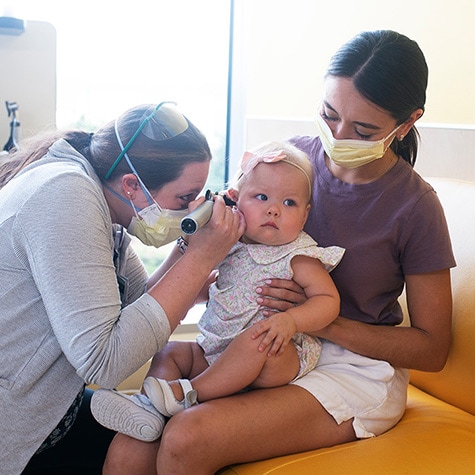
The experts in our Hearing Loss Program provide a wide range of services to help address pediatric hearing problems, including evaluations, treatment options, therapy and newborn screening.
Learn moreGetting a cochlear implant is just the beginning—adjusting to the hearing and speaking world can be difficult for your child. That’s why we offer a multidisciplinary approach through a team of otolaryngologists, audiologists (hearing specialists), speech-language pathologists, social workers and child psychiatrists.
After cochlear implant surgery, our team members will train your child to identify and understand new sounds that they couldn’t hear before with hearing aids. This instruction will give your child the best possible foundation for developing spoken language skills.
Post-surgical rehabilitation includes:
- Setting speech and language treatment goals, which are specific to the child’s level of listening skills.
- Collaboration between audiology and speech services to help make sure your child is getting maximum benefit from the implant.
- Mapping (or programming) the implant to create the best speech outcomes.
- Troubleshooting and problem resolution.
- Soliciting input from teachers and other caregivers.
Therapy is family-focused, and each session includes parent participation and home activities. Our cochlear implant team uses an auditory-based approach, which emphasizes listening as the primary mode to develop spoken language skills. We provide ongoing evaluation for your child to determine if they need additional treatment or services.