Season 2, Episode 3
Hope and Will: A Parenting Podcast from Children's Healthcare of Atlanta
Keeping Kids Safe in Cars: Why “Just this Once” Isn’t Worth the Risk
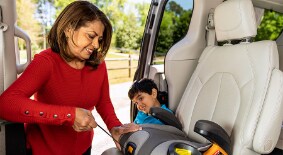
Few things are more intimidating to a new parent than buckling a baby into their car seat for the first time. Then you blink and that same child is pressuring you to retire the booster seat—or even sit in the front seat—to be more like their friends. Whether moving from rear-facing to front-facing, graduating from a booster seat to no seat, or moving from the backseat to the front seat, it’s often tempting to progress to the next phase of car passenger riding just a little early or just this once.
On this episode, we’re joined by two guests whose stories will give you confidence to stand your ground. Deanna Lundin was wrapping up a work day when four of her kids were passengers in a serious accident just around the corner from their home. April Dorsett is a pediatric nurse who leads the Safe Kids coalition in Athens and enjoys being a go-to child passenger safety resource for organizations throughout Georgia. By the end of the episode, you’ll have a newfound appreciation for child passenger safety laws and better understanding of how to access free resources to help you feel more confident about the choices you make for your family.
Listen to this episode on your preferred podcast platform: Apple Podcasts, Spotify or Amazon Music.




Lynn Smith: There are few things more intimidating to a new parent than buckling baby into his or her car seat for the first time. I've been there. Then, you blink, and that same child is pressuring you to retire the booster seat or even sit in the front seat to be more like their friends. Whether moving from rear-facing to front-facing, graduating from booster seat to no seat, or moving from the back seat to the front seat. It's often tempting to progress to the next phase of car passenger riding, even just a little early or allowing it just this once.
Today, I'm joined by two guests who will share stories and insights that will give you new perspective on just a little early or just this once. Deanna Lundin is a Georgia mom who got the dreaded phone call that an SUV carrying all four of her kids had been in a very serious car accident while she was at work. April Dorsett is a pediatric nurse who leads the Safe Kids Coalition in Athens and is a go-to resource throughout the state for her work in child passenger safety. By the end of the episode, you'll have a newfound appreciation for child passenger safety laws, as well as resources to help you feel more confident about the choices you make for your family.
I want to welcome Deanna and April to the show. Deanna, thanks so much for being here. I want to start with you. Before we dive into your story and that day that forever changed your family, help us get to know your family a little bit better. Tell us about your kids and your husband.
Deanna Lundin: My husband, Grant, and I are both born and raised in Nebraska. We have five kids. I have my stepson, Colin, who is 20. Then we have four children together, Mia, who is 10, Catherine, who turned 9 yesterday, Abram, who is 7, and Beau, who is 3. We have been in Georgia for one year. We're always looking for the next big challenge. So, we picked up and moved down to Georgia—making new memories, meeting new people and living our best life.
Lynn Smith: There was that moment that day, a scenario that keeps parents and kids of all ages up at night, a horrific car accident that your children, four of them experienced with your nanny driving. Tell us exactly what happened that day.
Deanna Lundin: I was at work. with my four children and our nanny came to pick them up from my job and drive them home. She's driven them every Thursday all year long and she's wonderful. She was going to drive them home, and I transferred all car seats for all my kids and her car all except for Catherine because Catherine is 8, almost 9. And she just asked, “Do I have to? It's a short trip. It's no big deal.” Unfortunately, I agreed to it. They hopped in the car. Started on their short trip home, about five to seven minutes into the trip, I got a phone call from the nanny. It was a very short call. She just said, you have to get here. We rolled over. There was a crash. I think they're okay. And that's all I heard.
I grabbed my keys. Another wonderful parent at my work noticed that I probably shouldn't be driving, took my keys from me, which I'm so grateful for now. We were following behind the fire truck and the ambulance driving to the crash site. The whole time I'm driving, I'm just thinking all four of my kids and I just don't know.
Lynn Smith: Tell me about that moment when you got there, getting out of the car. What was going through your mind?
Deanna Lundin: Traffic had stopped going both directions because of the accident. It was in an intersection. They had been t-boned by another car coming out of the intersection of the neighborhood from the street they were driving down. The car flipped four times. It landed upside down on the sidewalk across a whole lane of traffic. When I arrived, we pulled up onto the sidewalk, and I got out of the car. I just took off running and as I'm running, I see the ambulance and then I see the fire truck. I see the car. It's upside down and just in pieces, but I can't see my kids. There was some hedges in the way and a little grassy hill behind it. As I got right up to the edge, I just stopped running. There was just a moment of clarity where I thought to myself, “This could be the very last moment where my life is okay. This could be the last moment where I know all four of my kids are alive.”
It was terrifying to take those next steps. I was scared. I was terrified. I took a deep breath, and I braced myself for whatever was going to happen next. I came around the corner, and my nanny's mom was already there. She came running towards me, and she gave me a hug. She said, “They're fine. They’re fine.” She walked me over, which God bless her, I needed that. I needed someone to walk me there. And they were all sitting on the hill. And, thank God, alive.
Lynn Smith: Tell me what was going through your mind the moment you saw your children sitting there going from what you just described of this could be the end of everything to my babies are okay.
Deanna Lundin: The human brain is so amazing. It would not let me fully go there to, to the point of thinking what it really would have been like had I lost any of them, let alone all of them. I was hugging them, kissing them, so thankful, hugging my poor nanny, who was also safe. Just being so grateful. So grateful.
Lynn Smith: April, you hear this, and it's gut wrenching that Deanna had to experience this. Tell me about what was so important about what they did safety-wise that ensured that all five people in that car, her four children and her nanny included, were okay.
April Dorsett: Car seats and seatbelts saved lives. It's just so important through years of research and so many horrific accidents, we learn how important it is to install a car seat correctly and to use it every time. Buckle up every time you get in the car. A lot of accidents happen within a mile of where you're going. You're not alone think, “Oh, it's just down the road. It's really close to home. We'll be fine. You just don't ever know.
Lynn Smith: I've seen the photos of the car and it's one of those things that you would assume when you see the photographs, no one could have survived this. For those of you listening, you can visit choa.org/podcast. You can see these photos for yourself. The car was knocked up into a sidewalk, completely upside down, airbags deployed. Deanna, you said one of your children suffered a little injury. Can you tell about what that was and how they're recovering?
Deanna Lundin: My younger daughter, Catherine, was 8 at the time of the accident. Like I said, I think a lot of parents run into this same thing. You're right at that bubble of maybe they don't need a booster seat anymore. She's tall for her age. Just this one time going close to home. My nanny made sure my younger son was in his booster seat. Nobody was sitting in the front seat. My 3year old was in his five-point harness, which was correctly buckled into her back seat. She made sure his chest clip was up across his chest. Had it been down at his stomach, he could have flown out of his seat. Had it been up at his neck, he could have choked and strangled while he was hanging upside down.
But I told my daughter, “Sure. This time, you're just going home. It's no big deal. You're in the backseat. You're almost 9.” The seatbelt did not protect her the way it was supposed to. She received neck lacerations. She ended up with a CAT scan because they were afraid of internal injuries in her neck. She received lacerations along her thighs and bruising on her back. You could clearly see from these marks from the accident that the seatbelt did not hit where a seatbelt should hit. I am forever thankful that she was at least big enough that she did not fly out of the car. Had she been much smaller, that seatbelt would have done nothing.
When you flip four times and land upside down, you need all the help you can get. We've learned a big lesson that way. There's no such thing as too short of a ride. There's no such thing as you're almost big enough. It's every single time. Make the right choice every time, because you don't know when that time is coming, and it's not even you. Someone else could cause an accident.
Lynn Smith: I’ve been guilty of this before where we're just going around the corner. How many of us have been there? It's such an important lesson. It's why I love hosting this podcast because every single time I learn so many important lessons. Just do it every single time. No exceptions. April, will you walk us through what those standards are age wise when it's the right time to move from car seat to booster and booster to regular seat? That one mistake of cutting corners can mean the difference. Thankfully, in this case, not life and death, but in other cases it could.
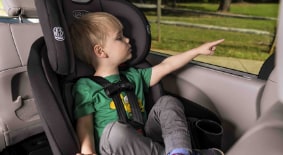
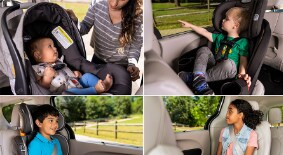
April Dorsett: From birth, it’s a choice. Parents a lot of times like what we call an infant seat and it is truly an only rear-facing seat. A lot of times it comes with a base. You have the convenience of securing the base into your car, and it stays there. Then the carrier will unclip, and you can carry the infant in and out of the car easily. You can also use a convertible seat, which is rear-facing up to a certain weight. Then it converts and forward-facing to a certain weight. That seat is a five-point harness. The infant seat is a five-point harness. The convertible seat is a five-point harness.
Then, you move to a booster seat. I like the high back booster seat because you have that extra side impact protection, but it also has a feeder for the seat belt. You can ensure the seat belt strap is in the proper place going across the shoulder and the chest and the hip belt going across the hips and the top of the thigh and not on the stomach. A lot of kids around your daughter's age, 7, 8. They think they're big kids. They don't want to be in a booster. They don't think it's cool. We see a lot of kids not in a booster at all, or they're sitting back there with just the regular seat without the back touch. They'll have the belt across their lap, but then they just take the shoulder strap and put it behind them.
We say, keep your child in that harness as long as you can before you transfer them into the next stage of seat. The guidelines that we follow is anybody under the height of four-foot nine should be in a booster seat or car seat. If you're not four nine, then you need to be in the convertible seat or a high back booster seat, because we know that you're not tall enough. For that car seat, the seat belt to be in the proper place, we do a test. We make them sit in the car seat, in the automobile seat, and you have to be able to sit all the way back. If you're back against the seat, your feet are bending. Your feet have to touch the floor of the automobile. When you put that seat belt on, we make sure that it is not up on the neck, that it is coming across the shoulder and across the hip bone. Then you can be in a seatbelt.
We do car seat checks at elementary schools. We know that because of their ages, they need to be in either a convertible seat or some sort of booster seat, and a lot of times they're not. Every car seat comes with height and weight parameters. We really go more on the height and weight of the child and what seat they should be in because every kid is different. Some kids are very tall for their age. Some kids are very small for their age. On every car seat, on each side, you're going to have the English and Spanish, and it will tell you rear facing this seat will go from five to 40 pounds or on the convertible seats. It will say this seat will take you from five pounds to 65 pounds, but they want you to stay rear facing until you go over that height and weight for rear facing. Then, you forward face wearing the harness. My kids would argue with me. They're like, “I don't want to be in this,” but I made them stay in that harness until they had topped out of their seat. Then, we transitioned into a booster, but I always made them have the high back booster because I could thread that seat belt through. It's a little more reassurance and less likely for them to try to slip it behind them and not stay buckled in. Every child is different. Some kids are pretty compliant about staying in their harness or their seatbelt. I think that consistency starting from early on and them just getting used to this is how we ride in the car. We're not leaving until everybody's buckled. That really helps a lot.
Lynn Smith: I know that you gave us all the things we should be doing. What are some of the common, seemingly no big deal things parents do? We were talking about, “Oh, it's just around the corner. No booster’s fine.”
April Dorsett: We see frequently that the seat itself has not been properly attached to the car. Every car seat, there are two ways that you can attach your seat. You can use the latch and a tether or you can use the actual shoulder lap belt to attach your car seat to your automobile seat. Whenever we're installing a car seat, we refer back to the manual of the seat and the actual car manual, because there's not one set rule. Every car is different. Every car seat is different. Every single seat has different rules. We have to make sure that we are installing that seat by the manufacturer's rules and also making sure that it fits that car. Some parents will say, “If one way is good, then both is best.” If you look at the manual, it's either/or, it's not both. A lot of people don't even understand that latch and tether is even an option in their car, but there are always little rings, little circles in your car seat. Right up above where that latch is. If your car is too old, then you're not going to have the latch tether, but all new cars now have both options. When you're rear facing, you don't use that tether, you only use the tether. When the car seat is forward facing, but using that tether when it's forward facing is just securing that seat even better.
Another thing that we find that parents don't do is checking the movement of that seat. As a technician, when we're installing it, we want it a good snug fit. Whenever we check the movement of the seat, we're always going to check the movement. Where the actual seat is attached to the car, not up at the top or on the side. We don't want it moving more than an inch. I see a lot of times the seat has not been restrained tight enough. There's too much movement.
The other thing that we see frequently is the chest clip in the wrong place. The chest clip, we always tell parents to put your fingers in their armpits and go straight across the chest from the armpit in the center of the chest. On that bone is where you want that chest clip because that's going to protect from any soft tissue or internal injury from that chest. Also, we'll see the actual straps are not snug enough or they're in the wrong place. Believe it or not, there's a different set of rules when the seat is rear facing. You want those straps to be at the shoulder or can be a little bit below the shoulder. That's for rear facing. For forward facing, you want those shoulder straps to be at the shoulder or can be a little bit above.
We're always adjusting shoulder straps. And some car seats, the more basic car seat, you have to manually change those straps. If you're doing it right, then you're changing those shoulder straps pretty frequently. Some of the car seats, the more expensive the seat, the more features you get where you're not having to do that manual.
I do want to point out that there are many reputable brands of seats out there. If you bought the very basic to the fanciest, the car seat safety is the same. They crash test those seats and that part doesn't change what you're paying for more in a more expensive seat is more of the convenience things. The fact that you're not having to manually adjust something yourself, it does it automatically, or the fabric on the seat might be a little fancier or prettier, but it's not going to compromise the safety.
The other thing is we always educate parents about the importance of not putting your child at any age into a car seat or a booster seat with bulky clothing on because that bulky clothing would create space in between the strap and the seat. Parents will say, “What if it's cold?” If it's cold, then lay a blanket across their lap.
You want to put them in the seat. Make sure that their back is all the way up to the seat, and they're snug in that strap with nothing bulky on. I'd say those are the main things, chest clip, the straps being adjusted correctly, making sure that your child is within that weight range that they're either rear facing or forward facing at the right time. Then, making sure that your seat is secure to the automobile.
Lynn Smith: What is the age for front seat?
April Dorsett: You should not sit in the front seat if you're under 13, 13 is the rule. So, 12 and under, you need to be in the back seat. If you're a small 13 year old, I would tell the parent they need to stay in the back seat because the biggest safety issue with the front seat or the airbags. That airbag itself can do a lot of damage to the child. That's why we want to keep them in the back as long as possible.
Lynn Smith: Deanna, hearing everything that April has said safety-wise, just knowing what the different outcome could have been, if one of those things were compromised, what does that make you feel like?
Deanna Lundin: It makes me grateful for all the knowledge and information that is out there and for all the people who do the work that April does. That's hard when you have a 12 year old who says, “I'm just going to hop in the front to run to my friend's house.” You've argued with them all day—what they're going to wear and what they're going to eat. It's so much easier to say, “Sure. Jump in the seat next to me.”
You have to be the parents. I always try and tell myself that their job is to be the child and ask for the things that they want. My job is to be the parent and make sure they do the things they need to do. Anytime your child is in a car with someone else, it's a parent's job to tell that person who's driving, “These are our rules for our family,” and to make sure your kids know every time you're in anyone's car, this is what you do.
April Dorsett: That's a good point because I think not every parent has those same standards. I would always have to argue with my boys. I've been through a personal experience, but also with my years of being a pediatric nurse and then working in surgery realm for a long time and then in education and being the Safe Kids coordinator and seeing all of what I see, that's what I would tell them. I'm like, “I'm sorry, I'm your parent, and I'm making you do this because of what I know.” Maybe those parents don't know what I know, but I can't.
Lynn Smith: This is very personal to you. You yourself were in a car accident at 14 and that's what inspired you. Can you tell us a little bit about that?
April Dorsett: I was 14 years old. I had spent the night with a friend. This was March 14, 1984. That is the year that Georgia made seatbelts a law. At that point, it still was not the law. In fact, that morning, there were five of us in the car and three of us were in the ninth grade. When we had our accident, the state patrol officer drove past us. He did not see us out in the field because it was so foggy that morning. He was going to our class to talk to us about seatbelts, but we were driving too fast. It was really foggy that morning. The girl who was driving was 16. This was way before cell phones, but she was distracted. She looked down in her lap at her notebook.
We were on a small country road down in South Georgia. We ran off the right hand side, and she overcorrected. We went off the left hand side. We flipped, they think, three or four times, and we were all ejected from the car. She was killed. I was severely injured. We were all injured very badly, had multiple fractures and were in the hospital for a long time. That taught me at age 14, how quickly your life can change.
While I was in the hospital, I loved my nurses and I thought, “Wouldn't it be so cool if I grew up and could be a nurse and take care of children?” I went to nursing school and became a pediatric nurse and spent the first eight years of my nursing career in pediatrics. Here I am 29 years into my nursing career, and I have taken on Safe Kids Coalition for Athens. I cover three areas, Oconee, Oglethorpe and Clark County. I spend all of my time educating about injury prevention and a big focus of what we do is on car seat education. I became a car seat technician. Whenever I'm talking to parents, I'm preaching like, “Look, I've been through it.” I can show kids the scars on my arm.
Lynn Smith: I can say it's very important that you wear your seatbelt. It's an unbelievable story. I didn't know what Safe Kids was until this episode. I didn't know that car seat technicians existed. Tell me a bit about. the program. And also, is there a cost to see safe kids in a car seat technician?
April Dorsett: Everything is absolutely free. Safe Kids is worldwide. It's a non-profit organization that is global. In the United States, there are about 400 coalitions. And in our state of Georgia, there are about 30 coalitions. Our hub, our state administration for Safe Kids, is at Children's Healthcare of Atlanta. It's just a wealth of knowledge. You can go to the website, safekids.org. There's so much information there about all of the different focus areas, including a lot about car seats and how to find a car seat technician. Most areas have a car seat technician.
A lot of people think that the fire department, that's their first go-to idea. That is a great place to start. I will say that not all firemen are car seat technicians. Not all police officers or state patrol officers are technicians, but there are usually one or two within those organizations. If you just Google “car seat technician near me” or safekids.org, or you can go to the National Child Passenger Safety Technician website that will give you all of that information of how to find a car seat technician or if you wanted to become a car seat technician, you can take that class.
Lynn Smith: It's really just important to make that point that it's not just the first place to go is the fire department, right? It's like this myth that everyone thinks to go there.
April Dorsett: They're awesome, and they always want to help. They probably would do what a parent would do if you get the seat and it comes with a manual. You start going through the manual and try to figure it out, but sometimes, even as a car seat technician, it's confusing to figure out from looking at the pictures or your car is different. Most car seats come with the manual that has a 1-800 number on it. It also has a link where you can go and watch a video.
For me, I like to learn visually. That's really informative. If you run into a problem, you can call the 1-800 number to that car seat manufacturer. They will have someone that that can talk you through or answer questions.
Lynn Smith: People don't realize how important of a topic this is because road injuries are the number one leading cause of unintentional death in children. It is stunning when you hear that, and there's other things that we hope that people learn from this episode like car seats expiring. I didn't even realize that was something that happens. Are there options to find information about your car seat and to get rid of a car seat?
April Dorsett: One of the very first things that we do is flip the seat over and on the back, every car seat should have that model number. It will tell you the name of the seat, the model number. It will tell you the date that it was manufactured, and it will tell you the expiration date. If we're checking a seat, and we see that it is expired, we're going to get rid of that seat. We'll have a new seat to give to that family. When it expires, we take scissors and cut all the straps so that we make sure that if you were to throw that seat, in the trash or at the curb, we don't want somebody else coming and taking that seat and being able to use it.
We always recommend when the seat is expired that you go ahead and cut it so that it can't be used again. You can even mark with the sharpie, do not use. There are counterfeit car seats I've been hearing about. We have seen two in the last six months here. The first one was an infant that was in NICU and thankfully the nurses that were doing the car seat test on that NICU baby are car seat technicians. They were looking at this seat, and it looked a little bit off. They noticed that one didn’t have a model number on the seat. They couldn't find the expiration date or any of that information on that sticker. The stickers on the side that show like the height and weight. Requirements were peeling and just weren't quite right. Then they started trying to look things up, that's when they discovered this seat is counterfeit. And the thing is, the parents had spent a good amount of money on this seat. It was a popular brand that a lot of new parents are wanting to purchase because it has the infant seat that also clicks into the stroller. They were pretty upset because they had bought it online.
We will warn parents to make sure that you're buying your seat from a reputable resource, a place that you can go into, a brick-and-mortar store. If you're ordering it online, make sure that you're ordering it directly from the manufacturer. Be careful that you're not buying it from some third-party distributor that you've never heard of before. If you come across a seat and it's normally $700 and you're paying $300, I would question that. I would question that this seat could be counterfeit because that's almost too good to be true.
Lynn Smith: Lastly, there are some other items you want to make sure are secure. They could become projectiles. Can you share a bit about what that is?
April Dorsett: Your cell phone, water bottles, toys. That's another thing. When we are installing car seats, we don't allow any aftermarket product to be used with that seat. Some car seats today may come with some extra little pieces that go on the seat, like a cup holder, or it may come with something that you can put underneath the seat to protect your car seat. Most car seats do not come with those things. We'll see a parent has installed the car seat on top of a towel. Don't do that because this car seat was crash tested without that towel. You want to install it the way that it was crash tested. If you read your manual, it's going to tell you what is accepted or not accepted for anything after market.
When you're in a car, anything that is not secured in a big enough crash will be a projectile missile. That's another thing with booster seats that we remind parents. If you have a free-floating booster seat in the back seat of your car, and the child is not in it, you need to buckle that booster seat in when the child isn't in it. That booster seat is a missile. If you're in a car crash, the kids not there, but that booster seat can come forward and whack you.
Lynn Smith: It's such important information that you just wouldn't think of. Deanna, I want to close with you. What would you say to anyone who might be contemplating moving up to the next level of car seat, maybe just a little bit earlier, tempted to occasionally loosen those rules for a short drive around the neighborhood, because had you done that, it would have been a much different conversation we'd be having today.
Deanna Lundin: Bottom line is don't do it. The health and wellness and safety of your child so far precedes their desire to want to be a big kid, their desire to want to sit in a seat.
Lynn Smith: It's this reminder for all of us, this episode in general, is every single time you graduate to the next level you really are downgrading in safety, so you want to make sure it is at the right time, not cutting corners. Deanna and April, thank you so much for joining us.
To find helpful resources to help keep your kids safe in cars, including how to find a safe kids or car seat technician near you, visit choa.org podcasts where we're going to link a lot of emotional wellness content. You'll find links to car seat safety guidelines from Strong4Life, as well as those harrowing photos of the London family's car accident.
To make sure you don't miss an episode, be sure to subscribe or follow hope and will wherever you stream your podcasts. I'm Lynn Smith and this has been Hope and Will, a parenting podcast from Children's Healthcare of Atlanta.
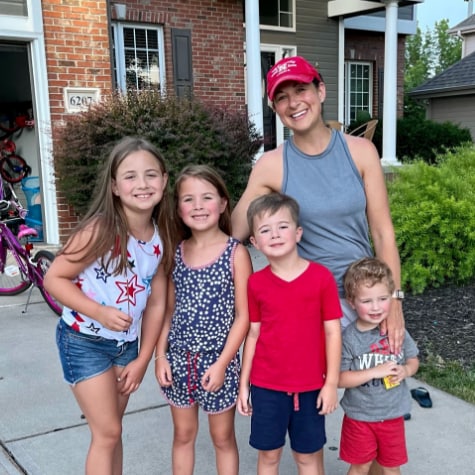
Deanna Lundin, Mom to Mia, Katherine, Abram and Beau
In May 2023, Deanna’s world came to a screeching halt when she answered a phone call from her nanny. An SUV carrying her kids, ranging in age from 3 to 10 years old, had been T-boned and flipped multiple times. Deanna shares how decisions her family made regarding the kids’ car seats, booster seats and seatbelts—even for a short, familiar, highway-free ride close to home—paved the way for their survival.
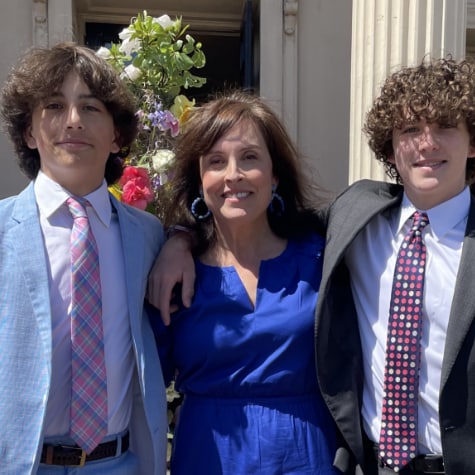
April Dorsett, RN, Safe Kids Athens Coordinator, Certified Child Passenger Safety Technician
On the way to high school in the 80s, April was one of five teenage passengers in a car that crashed on a foggy, two-lane country road. The driver died, and April spent weeks in the hospital recovering from serious injuries. April, now a proud mom of two teenage boys, went on to become a pediatric nurse and has since dedicated much of her career to helping parents make safe choices for their kids while on the road.

Lynn Smith
Lynn Smith is a veteran journalist, podcast host and mom of two boys. Her experience as the parent of a patient at Children’s inspired her to advocate for spreading awareness of childhood illnesses and injuries.