Jenna's Story
Innovative Diaphragm Pacing Surgery Makes Greater Independence Possible for Teen
Less than 10 pediatric hospitals in the U.S. perform diaphragm pacing. After consulting with hospitals nationwide, a family from Nebraska chose Children’s.
Our Pulmonology and Lung Surgery Program ranks No. 20 among the nation’s top pediatric hospitals on the U.S. News & World Report list of “Best Children’s Hospitals” for Pulmonology and Lung Surgery and provided care to 20,000 unique patients in 2025.
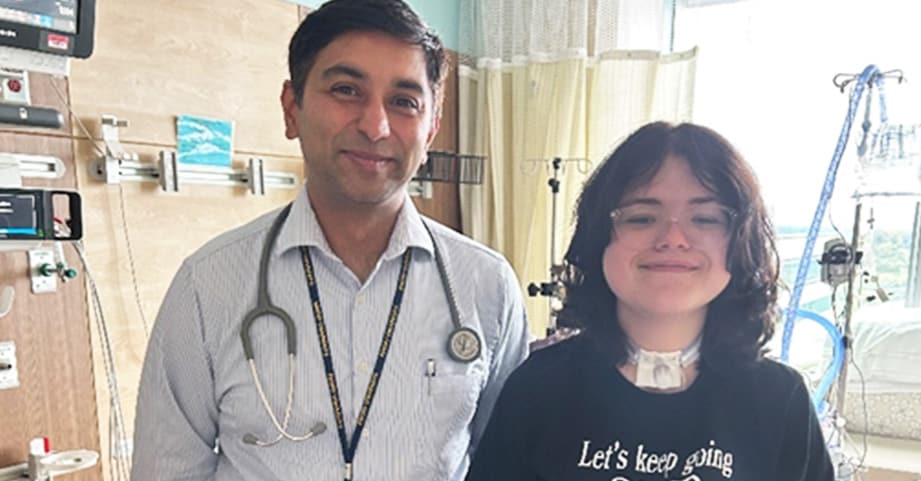
In the time it takes to read this sentence, most people will inhale and exhale several times without realizing it. That seemingly simple, autonomous action is a luxury that families like the Bensons of Lincoln, Nebraska do not take for granted.
Other than being treated for a higher-than-normal amount of amniotic fluid, Lauri Benson enjoyed a mostly normal pregnancy as she prepared to welcome her third daughter, Jenna, into the world. What Lauri had envisioned for their first moments together—uninterrupted snuggles with her last baby in arms—quickly gave way to the scariest moments of her life.
Baby Jenna was struggling to breathe, and it would be several agonizing weeks before Lauri would finally get to hold her. Her oxygen levels were low, and her carbon dioxide levels were high. Two very long weeks later, genetic testing confirmed congenital central hypoventilation syndrome (CCHS)—a rare condition of the autonomic nervous system that affects less than 3,000 people worldwide. In a healthy person, the brain responds to changes in oxygen and carbon dioxide levels by breathing deeper or faster, while also demonstrating physical signs of distress. For people with CCHS, the body has no response when oxygen levels dip dangerously low or the carbon dioxide levels are elevated.
To survive, Jenna would require a tracheostomy—a surgically created opening in the windpipe that allows air to enter the lungs—and lifelong ventilator support. After five months in a neonatal intensive care unit, Jenna went home for the first time to an apartment her family rented just one week prior so they could be close to the hospital in case of emergency.
As Jenna grew from baby to toddler to elementary schooler to teenager, the disease took its toll on her physically and emotionally. Prone to infections that put her at high risk for pneumonia, she left her beloved school to begin homeschooling. Many of the rites of childhood, like walking through a local park, required advanced coordination to account for her ventilator, which also greatly limited her mobility.
By the time she turned 16, Jenna had had enough. She yearned to experience some of the freedoms enjoyed by her peers. Inspired by Jenna, Lauri had gone back to school to become a respiratory therapist. Through her work, Lauri learned of a new procedure called diaphragm pacing surgery. A small and portable device that does not require tubes, a diaphragm pacer allows children to participate in school and other activities by affording breaks from being tethered to the ventilator circuit.
There are fewer than 10 pediatric hospitals in the U.S. capable of performing the procedure. After consulting with hospitals nationwide, the Bensons found the perfect partner in the diaphragm pacing team at Children’s. Atlanta was neither the closest location nor the most convenient for the family but, after one call with Pediatric Pulmonologist Ajay Kasi, MD, they knew they’d found the perfect fit. The Bensons had full confidence in the Children’s skilled multidisciplinary team which includes a pediatric cardiologist, critical care medicine doctor, general and thoracic surgeon, geneticist, pulmonologist, respiratory therapist and sleep medicine specialist.
“To drive 15 hours each way, you have to know you are going somewhere that really cares,” Lauri said. “And we found that immediately with Dr. Kasi. From the moment we first connected, he regularly checked in to hear how Jenna was doing and updated us every step of the way with progress on the procedure. A surgery as complicated as this requires a ton of coordination with everyone from insurance verifiers to the OR staff, and everyone was incredible to work with.”
The procedure itself—thoracoscopic implantation of phrenic nerve electrodes for diaphragm pacing—is technically challenging for even the most skilled surgeon. Anesthesia naturally suppresses a person’s drive to breathe, which is especially dangerous for someone whose body is incapable of self-regulating oxygen and carbon dioxide. Because the phrenic nerve runs directly behind the heart, one lung must be fully deflated to access the phrenic nerve and implant the electrode. Subsequently, the other lung is deflated, and the procedure is completed on both sides.
Careful collaboration between specialties and the entire surgery team was going to be key. Matthew Clifton, MD, Chief of Pediatric Surgery at Children’s, would lead the way, having performed several successful surgeries. Dr. Kasi also would be on hand to provide expertise. And since Jenna also has a cardiac pacemaker, it was important that cardiologists—Chad Mao, MD, and Andrew Peter, MD—were in the operating room to ensure that signals from the diaphragm pacemaker didn’t interfere with the cardiac pacemaker.
In late 2025, Lauri and Jenna headed out for their more than 500-mile road trip. When they arrived at Arthur M. Blank Hospital, they felt a surprising sense of calm.
“It’s hard to explain, but we just knew we were where we were supposed to be,” said Lauri. “The facility itself is beautiful and state-of-the-art, but it’s got nothing on the people who bring it to life.”
As the team wheeled Jenna back for the three-hour surgery, Lauri held back tears. The operating room was standing room only, with Drs. Clifton, Kasi and Mao working in concert with the operating room team. Just two days later, Jenna asked to go for a walk. By day three, she was discharged. On day four, the family headed out for the 15-hour drive back to Nebraska.
Words cannot convey what an amazing experience we had at Arthur M. Blank Hospital,” Lauri said. “From the woman who took our pictures on our badges to the security guards to the nurses, the sheer kindness of the people we met at Children’s moved us to tears on more than one occasion. It’s the kind of stuff you see in movies but never expect in real life.”
For four weeks after the procedure, Jenna’s body worked to heal from post-surgical inflammation. Eventually, Jenna’s pulmonologist and cardiologist in Nebraska worked in tandem with the Children’s team to turn the diaphragmatic pacemaker on for the first time. This marked a new chapter for Jenna, who is looking forward to experiencing more and more freedom as her body continues to adapt to the device in the months and years ahead.
Ajay Kasi, MD, is a pediatric pulmonologist at Children's Healthcare of Atlanta and an Associate Professor of Pediatrics at Emory University School of Medicine. He is the Medical Director of the Technology-Dependent Pulmonary Program at Children's. He established the Diaphragm Pacing Program and a multidisciplinary program for children with congenital central hypoventilation syndrome. This unique program is one of only a few of its kind in the country and receives referrals from across the nation. His areas of expertise include cystic fibrosis, congenital central hypoventilation syndrome and home mechanical ventilation.
Some of Dr. Kasi’s recent research publications include:
- Images: Atypical resolution of sleep-related hypoventilation in congenital central hypoventilation syndrome. Yoo M, Shah A, Shahrour H, Li H, Kasi AS. J Clin Sleep Med. 2025 Jul 1.
- Family Caregiver Knowledge in the Outpatient Management of Pediatric Tracheostomy-Related Emergencies. Truitt BA, Ghosh RN, Price EW, Du C, Bai S, Greene D, Simon DM, Reeder W, Kasi AS. Clin Pediatr (Phila). 2025 Jul.
- Vanzacaftor-tezacaftor-deutivacaftor for children aged 6-11 years with cystic fibrosis (RIDGELINE Trial VX21-121-105): an analysis from a single-arm, phase 3 trial. Hoppe JE, Kasi AS, Pittman JE, Jensen R, Thia LP, Robinson P, Tirakitsoontorn P, Ramsey B, Mall MA, Taylor-Cousar JL, McKone EF, Tullis E, Salinas DB, Zhu J, Chen YC, Rodriguez-Romero V, Sosnay PR, Davies G; VX21-121-105 Study Group. Lancet Respir Med. 2025 Mar.