Why Can’t My Child Poop?
If your child has been sitting on the potty with nothing to show for it, you’re not alone. Learn more about symptoms, treatment options and how to help kids with constipation.
Constipation is a common childhood issue. Kids who are constipated may have infrequent, hard, dry, difficult or painful stools (bowel movements).
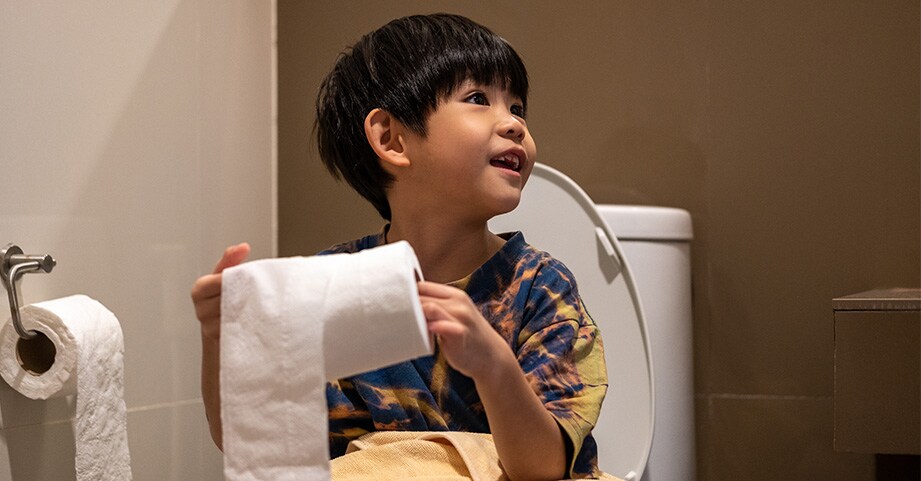
What causes constipation in kids?
Childhood constipation is often caused by:
- Diet.
- Lack of hydration.
- Holding stools.
- Bathroom avoidance.
What are some common signs and symptoms of constipation in kids?
A child may be constipated if they have:
- Abdominal pain or cramping.
- Large, hard and painful stools.
- Blood in the stool or on the toilet paper.
- Stool accidents or soiling in the underwear.
- Loose, sludgy stool that is difficult to control.
How often should my child poop?
Each child is different. Some children will poop once a day while others may go multiple times a day (ex. after every meal). The most important thing to note is the “softness” of a child’s poop.
How can I tell if my child’s poop is normal?
You can use the Pediatric Bristol Stool Form Scale for Children to help describe your child’s stools to your pediatrician.
- Type 1: separate hard lumps, like nuts (hard to pass)
- Type 2: sausage shaped, but lumpy
- Type 3: like a sausage or snake, smooth and soft
- Type 4: fluffy pieces with ragged edges, a mushy stool
- Type 5: watery, no solid pieces
Your child’s poop should be Type 3 or 4 on the scale.
What helps kids with constipation?
Treatment for childhood constipation may include changes to your child’s:
Diet
- Hydration: Make sure your child drinks plenty of water.
- Fiber: Encourage your child to eat foods that are high in fiber like whole grains, vegetables and fruits. It is best to get fiber from food, but supplements can be used for picky eaters. To determine how much fiber your child should be getting, take your child’s age and add five (up to 25 grams).
- Constipating foods: Limit foods that may lead to constipation (ex. applesauce, food pouches, bananas, cheese, excess dairy, rice, white bread, noodles).
Physical activity
- Make sure your child is physically active. Regular movement can help ease constipation by helping the colon work better.
Bathroom habits
- Have your child sit on the toilet for two to three minutes after every meal.
- Make sure your child has good posture while sitting on the toilet. They should sit up straight and uncross their legs to help relax their muscles and prevent straining.
- Have smaller kids use a footstool when sitting on the toilet to help with proper positioning.
- Don’t let your child watch screens or play with toys while on the toilet. Sitting on the toilet for too long can lead to constipation.
What to give kids for constipation
Medications may be used to treat childhood constipation in some cases. Talk to your child’s pediatrician about what medicines to give your child and how often.
Polyethylene glycol or PEG 3350, PEG 4000, magnesium hydroxide and magnesium citrate are over-the-counter laxatives that work by increasing water to the colon through osmosis. Osmotic laxatives like MiraLAX can be dissolved in liquid. This type of laxative is safe to use long-term as it does not cause dependency or malabsorption of vitamins.
Lactulose is a prescription laxative that works like MiraLAX. It is often used in younger children who cannot drink enough liquid to give MiraLAX.
Stool softener or lubricant laxatives
- Mineral oil or Kondremul is an over-the-counter lubricant laxative that works by lubricating stool, so it can pass more easily with less pain. This treatment is usually given for several days in a row until the large, hard stool passes.
- Docusate (Colace, Pedia-LAX liquid) is an over-the-counter stool softener that can be used in place of MiraLAX for maintenance or for quick relief.
- Magnesium hydroxide (Pedia-LAX) is a chewable tablet stool softener that can be used for maintenance.
- Senna (ExLax, Sennakot) is an over-the-counter medication available in tablet, chewable and liquid forms. It increases intestinal motility which helps push poop out of the body.
- Bisacodyl (Dulcolax) works as above. It comes in swallowable and chewable tablet form.
Enemas give immediate relief and may be used as part of initial clean out phase. Types of enemas include:
- Normal saline
- Mineral oil
- Sodium phosphate (Fleets or Pedi Fleets)
Suppositories offer quick relief, but they should not be used long-term due to dependency, negativity and weakening of the body’s natural stool reflex. They are available unmedicated (glycerin) or medicated (bisacodyl).
Where to go when your child is sick
If your child is sick or injured, it is important to know where to take them for care. Learn what can be treated at a pediatric urgent care center and a pediatrician's office.
Learn MoreContact your child’s pediatrician if your child has:
- Been constipated for more than two weeks.
- Belly pain that doesn’t improve.
- Frequent poop stains in their underwear.
- Bloody stools or very dark, tarlike poop.
- Trouble pooping and peeing.
- Green or bloody vomit.

Karen Dewling, MD, is a board-certified Pediatrician at Children’s Healthcare of Atlanta. She provides pediatric primary care services at Children’s Johns Creek Pediatrics and Children’s Forsyth-Cumming Pediatrics. Dr. Dewling earned her medical degree and completed her internship and residency training at Johns Hopkins School of Medicine.
This content is general information and is not specific medical advice. Always consult with a doctor or healthcare provider if you have any questions or concerns about the health of a child. In case of an urgent concern or emergency, call 911 or go to the nearest emergency department right away. Some physicians and affiliated healthcare professionals on the Children’s Healthcare of Atlanta team are independent providers and are not our employees.